

18 Writers' Advice on Writer’s Block, Generosity, Creativity Exercises, and Community
Keenan Norris collects the wisdom of experts to answer a young writer's letter


Be a verbal scientist, one who values actuality more than reality and who observes everything through the prism of discipline and imagination. Cultivate humility. Liberate your bicultural intelligence. WRITE.
Welcome to Writer In The World, the Wednesday section of Aimee Liu’s MFA Lore. This curated collection of reclaimed essays on the writing life and new videos of Writers in Conversation is produced by MFA faculty and alumni.
Aimee’s MFA Core essays on the craft and business of creative writing drop each Saturday. And her free Metaphortography Writing Prompts post every other Monday.
As an MFA Lore subscriber you can join our community and elect to receive some or all of these sections each week.
Save the Dates!
Our Bimonthly Loreate Zoom Salon
Saturday, August 8, 10amPT/1pmET
All paid subscribers welcome to this bimonthly gathering! We’ll discuss all the thorny issues of your writing life. Please RSVP in this chat thread so I can send you the Zoom link to join us:
Well Published! Live with
Dara Kaye, Nonfiction Literary Agent with William Morris Endeavor
Tuesday, August 11 at 10am PT
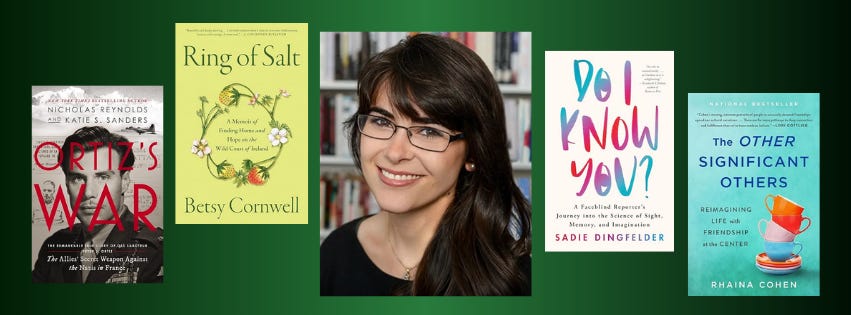
We’ll be talking about what it’s like to be a literary agent within a Big Deal entertainment agency, what kinds of nonfiction Dara loves to represent, and why she focuses only on this end of the publishing spectrum.
Take 5 Writing Workshop
Saturday, August 29, 9am PT/12pmET
This monthly workshop for Premium MFA Lore Subscribers allows us to take a close look at a different 5-page submission each month, tailoring feedback to the needs of each writer. To join, become a Premium Subscriber today.

Emails to a Young Writer, or I Am Not Friedrich Nietzsche*
by Keenan Norris
In compiling this collection I have found that I am, indeed, no Nietzsche. But I also, to my pleasant surprise, have found that my community is a kind of collective Rainer Maria Rilke, which is much better anyway.
Some time ago, a Southern California high school student sent me an email asking for tips on creativity and surmounting writer’s block. She told me that she was the student president of her school’s writing club and that not only she but her entire writing club eagerly awaited my response. My first thought upon receiving the email, dear reader, was not to delve my store of writerly wisdom for the appropriately sage yet pithy response. It may come as a surprise to those who have yet to struggle for years over a manuscript, its structure, pacing, character development and voice, but struggling over a manuscript’s elements for years— along with participating in the rest of life’s everyday struggles— does not necessarily leave a lot of time to bank a catalog of Nietzschean aphorisms. Well, I guess Nietzsche was able to do it, but I am not Friedrich Nietzsche.
I decided to ignore the email, or at least not to respond to it.
Because I’m more or less self-centered, I also fell to wondering how the student had happened upon me as her potential oracle. Had she read my debut novel Brother and the Dancer, which my publisher is now selling for the king’s ransom of $3.95 out of remainder bins, the equivalent of the clearance racks at a department store? Had the book been assigned to her by a teacher? I took note of the girl’s African name. Perhaps someone had suggested the book to her due to its classification as an “African-American coming of age” novel set in Southern California. Or maybe there’s a Random Novelist Name Generator machine out in the internet ether that simply renders up the names of writers to unsuspecting readers and aspirant writers. Who knows what these computer savvy kids are cooking up in the cloud.
It took a while, but eventually I came around to thinking of a response to the student’s query. Her email had found me at a low point: I was struggling with a new novel. Another work, my non-fiction book manuscript, had hit the skids with the publisher the book was contracted to. The illustrator I was working with on the first stages of a graphic novel had recently dumped me/my manuscript for paying pastures. I had a few short pieces set for publication here and there, but nothing that particularly qualified me to answer the student’s question with authority.
But the fact is that I am a writer. I’ve been a writer for a long time. Since I was a child, I’ve penned stories straight from my imagination. If memory serves, I even wrote a novel when I was in high school— luckily, there was no cloud back then so the thing is scrubbed from the human record entirely.
I write on couches, beds, hard-backed chairs, the cold cement slabs that decorate train station platforms. I think writers should weave writing into life. Make the one as fully consonant with the other as possible. We have compartmentalized our world. Everything has its very small, very cordoned space. This is wrong for writing, I think.
Relatedly, maybe, it is also important to remember that literature is media before it is art. Art is an achieved state, but everything published is part of the public discussion, subject to the whims of the powerful, respondent or dead to the immediate interests of the people.
Along with the experience I’ve built up working over the elements of fiction and fact, I have also convened quite a writerly community around myself. This is one of those things that is easily forgotten, particularly when we as writers are struggling in the difficult depths of our craft, let alone the brutal industry around it. We are a community of creators. Each writing group retreat, workshop, conference, reading, publication, and, yes, Random Novelist Name Generator correspondence that we have the privilege to be a part of builds that community. We are far from alone in this world full of stories and scribes.
My particular community stretches from the San Bernardino Valley of my birth and upbringing, across L.A. and up to the Bay Area, where I now reside. It stops over in Chicago and reaches down along the Mississippi into the South, New Orleans, where my novel ends and where I met the Black Arts Movement dean Jerry Ward, Jr., and out to the opposite coast, D.C., New York City, upstate, Toronto, Maine. It reaches across the water into the Caribbean and down to Brazil, where my scholarship took me in another life.
And it was on this community of writers that I called eventually, asking that they simply share with the student whose simple question had stirred me so their accumulated wisdom, their experience of this simple yet utterly demanding craft.
Writers, I have found, are generous people. So the responses flowed in. And, in fact, they continue to come across my inbox like so many gems scattered by an earthly event far, far away.
In compiling this collection I have found that I am, indeed, no Nietzsche. But I also, to my pleasant surprise, have found that my community is a kind of collective Rainer Maria Rilke, which is much better anyway.
Victoria Nelson, author of numerous novels, books of poetry and literary critical texts:
[Writer’s block] is a perfectly natural part of the creative process. The only thing to fear is getting afraid when it happens. Check out my book ON WRITER’S BLOCK, which puts the “block” or resistance as the path to figuring out what you really want to do in your writing—
Elena Georgiou , author of The Immigrant’s Refrigerator:
Remember writing is playing. Do it outside.
Remember you can do it anywhere at any time. Keep a journal by your bed. Record your dreams.
Remember that writing sometimes means daydreaming. Don’t write. Stare out of the window.
Remember that writing means reading. Read a poem a day. Take one line, and write from it.
Remember that writing means empathy. Listen to other people. Write down their words. Build a 100-word story.
Remember that writing means observing. Watch other people. Write a 200-word lifestory.
Remember that writing is a muscle. To make your writing muscle stronger, do it as often as you can.
Sherri L. Smith writes books, comics and graphic novels—including the award-winning YA novels Flygirl, Orleans and The Toymaker’s Apprentice. Her newest book is Who Were the Tuskegee Airmen? :
The best advice I can offer a young writer is to write. Stop talking about it. Stop sharing it with everyone before you do it. If you have an idea, write it down. Then revise it until it shines. Only then do I recommend sharing it with a good reader. A good reader is not someone who loves you, or someone who reads. It’s someone who reads openly, or in the arena in which you are writing. Your target audience is the best judge. Someone who loves you might be this reader, but there is a risk that they will praise anything you do, rather than offer constructive criticism. Likewise, someone who reads but does not read your genre might judge it from the wrong perspective. This is especially true if you are writing speculative fiction and asking a non-SF fan to give it a read. You want to be assisted, not dismissed or reduced. Lastly, open your senses, all six of them, and include them in your writing. You might know what it looks like, but how does it taste and feel? Immerse your reader in the world of your writing. That is, after all, the whole reason we read!
Hannah Schwadron, author of The Case of the Sexy Jewess:
Try this writing exercise: If you really knew me, then you would know…. Fill that in 5 times
Also: Get physical – 10 min of solid physical activity together as a group. Builds trust, community, laughter, love of each other, dopamine release
Venise Wagner, San Francisco Chronicle journalist and author of Love and Death in the Time of Pinochet:
When I first started learning the craft of writing I used one particular exercise that seemed to open my creativity:
You can start with a word. It can be an occupation, a food item, a favorite song. Anything. And do some free writing on that word for about 10 minutes. No thinking about sentence structure, word choice, grammar or anything. Just let the pen move on the paper and riff on anything that comes to mind associated with that word. Sometimes strong memories will arise and that allows you to tap into feelings and senses.
This exercise should be done with pen and paper, not on a computer.
Jerry W. Ward, Jr., author of THE KATRINA PAPERS: A Journal of Trauma and Recovery and editor of The Cambridge History of African American Literature:
Avoid texting, the thrall of selfies, the poison of ego-worship, and the banality of cognitive sloth. Study the denotative and connotative dimensions of languages. Listen to the music of speech. Maximize memory. Be a verbal scientist, one who values actuality more than reality and who observes everything through the prism of discipline and imagination. Cultivate humility. Liberate your bicultural intelligence. WRITE.
Soma Mei Shang Frazier, the author of Collateral Damage: A Triptych:
Start thinking of luminary authors, and everyone else you encounter, as peers as well as mentors. For if all human voices are crucial — though some may never be amplified — then we, as writers, must listen to others with rapt, equal attention. Likewise, we mustn’t be shy in gaining the specific skills needed to communicate our own urgent wisdom. So as you read your literary heroes, evaluate and emulate. Though they may be further along on their paths, they’re just people like you. And don’t worry about sounding ‘too much’ like one, for a brief period: copying is how babies learn to speak, and isn’t each of us a baby compared with those we admire? In time, the skills you borrow will combine to form your own distinct contribution.
Marc Anthony Richardson , American Book Award winner for the novel The Year of the Rat:
I want to briefly discourage any belief in blockage. You are not. Writing and life, as I’m constantly being reminded, is not about being inspired, but being willing to sit and listen. I’ve gone through two years, off and on, of not being able to sit and listen. The words are always there, but we are not present to receive them.
Also, it’s discipline. To be willing to sit for hours for a few sentences. It is what, I imagine, spearfishing is like. You’re knee-deep in the stream of consciousness. Standing so still as not to have your presence felt by the fish, even in their environment of constant movement. Ever watchful. Unmoved even by the dazzle of the sun on the surface. Your eyes, your hands, the spear you are holding are one in mind. And when you see it, that rainbow trout, you stick it with everything you are.
Khalid White, filmmaker and author of Black Fatherhood: Trials, Tribulations and Testimonials:
Select topics that are current, and/or that they are passionate about to write on. Then, do peer-share exercises and let peers critique, correct, edit each other’s work. Peer-to-peer work has helped me tremendously over the years. Especially peers with opinions and writing that I respect.
Darrah Cloud , playwright, TV writer and poet:
Dear writers, I think great writing comes with doing it every day, and not being afraid to revise, and reading everything you can get your hands on. So that is my advice: study what you read for how it works, how it’s written, not just for what it’s about. Ask yourselves questions and perhaps, as a group, talk about how a story is written. But ultimately, success goes to the people who show up. That’s my motto. If you write all the time, if you revise what you write to keep making it better, and keep a notebook for beautiful words and lines, you will be a writer. It’s a life-long thing, like breathing. It takes practice.
Emily Pinkerton’s long-form writing has appeared in The Bold Italic, Medium, Lemon Hound, and Yr An Adult, among others:
1) I take notes on what I observe in the world – colors, objects, patterns, etc. Often the things that we discount as unremarkable, fleeting, or ordinary can lead to great poetry or scenes in longer-form writing.
2) Read daily and write in response to what I’m reading. Maybe I’ll notice the sound/rhyme patterns a poet uses and try to recreate my own version of them. Maybe I’ll explore a fiction writer’s use of characterization.Sometimes I just take notes on what I like and why I like it.
I also try to write each day. Even if it’s just for a few minutes. It really makes a difference to have a regular practice!
Jervey Tervalon, author of Dead Above Ground, Monster Chef and other books mostly about the complexity of African American life:
Writing is a function of a passion to read. Writers who don’t read are an abomination. Have a thick skin and don’t be frightened to fail.
Jennifer Doyle, author of Hold It Against Me and Campus Sex, Campus Security:
Carry a small notebook with you and write thoughts down – anything. Draw. Doodle. Think of this as a way to nurture thoughts. No obligation for anything to turn into anything.
Related to above: keep a dream journal. Write when you first wake up, before you forget!
An exercise: take an image, something that feels very striking. The simpler, the more stark the image, the better. Describe only what is there. Be strict about that. make sure you write out the obvious. What feels obvious to you isn’t necessarily what feels obvious to others.
Description is an important skill – very necessary to a lot of professional writing.
Nayomi Munaweera , the internationally acclaimed author of Island of a Thousand Mirrors and What Lies Between Us:
I think the best advice for young writers is to read a lot. Read everything you can, classics, graphic novels, sci fi, whatever. If you’re not absorbing words almost continually, I’m not sure why you’d want to be a writer. The other thing that’s necessary is to write as much as you can. Journal (almost) every day. Learn to see the world with the writer’s eye. Watch the people around you and write about how they move, what they talk about, the shape of their lives. Look at the world around you, learn to describe nature, the sky, animals, your friends, everything with as much detail and surprise as you can. Try to make connections between things. This is essential training, to see what others do not see.
Patrick Newson’s first chapbook was published September (2018) by Nomadic Press:
For me, writing is like tying myself to a chair and removing all stimuli so that, if nothing else, my mind will struggle to escape. Once the initial anxiety and fear passes, my hands begin to scribble or type. The difficult thing is sitting still with nothing to distract me except more (mere) words. If I can sit still long enough, eventually the words will come.
Regis Mann, author of Resistance Reimagined: Black Women’s Critical Thought as Survival:
Especially when my schedule is hectic, reading is very important for my writing and research. I read a piece and keep a record of significant passages within it to which I can return later. Interspersed into those notes, in bold font, are my own ideas and questions. I reflect on why the quote resonates with me in the context of my own writing project. What do I seek to do differently than this author? When I come back to my own work, I often find an opening line or otherwise meaningful phrase embedded within my reading notes.
William Moor, experimental poet, author of birds of arizona:
1. Get something heavy and bulky enough (heavy bulky item aka “HBI”) that it is not easy to carry (for instance a large suitcase filled with rocks or a bag with a bowling ball).
2. Write something on a piece of paper and attach it to the HBI.
3. Carry the HBI around for a full day.
4. In the evening after you put down the HBI, read what you had written and ask yourself if it was worth it to carry the HBI for that very thing.
— If your answer is “no”, repeat steps 1 thru 4 the next day (you can reuse the same HBI)
— If your answer is “yes”, keep the paper attached and repeat steps 3 thru 4 the next day.
New! Take 5 EXTRA Editorial Feedback
If you’d like MFA-level feedback on work that’s longer than the 5-page limit in MFA Lore’s Take-5 program, you can now sign up for Take 5 Extra Editorial advice on a single piece of fiction or nonfiction prose (essay, story, or chapter—please, no sci-fi or horror) up to 6,000 words (approx. 24 pages, double-spaced).
For a flat fee of $275 you’ll get the benefit of my extensive career as a novelist, nonfiction author, ghostwriter, and MFA advisor, without guessing at the editorial cost. My feedback will aim at readying your piece for submission or publication and includes a personal advisory session.
*Originally published in The Writer in the World August 20, 2018
 | A guest post by
|