


A new installment from the Legacy side of Legacy & Lore*
When I was a child my father told me that his father was a scholar-revolutionary, a poet turned rebel who helped bring down imperial rule in China— and who wrote copiously throughout his life. As an adult, when I started researching and writing about my Chinese family, I discovered one of my grandfather’s books, a collection of personal “anecdotes,” in UCLA’s East Asian collection. I had this volume translated from my grandfather’s classical Chinese, and have been awed by his stories and perspectives ever since. But not all of these tales are easy to wrap my head around.
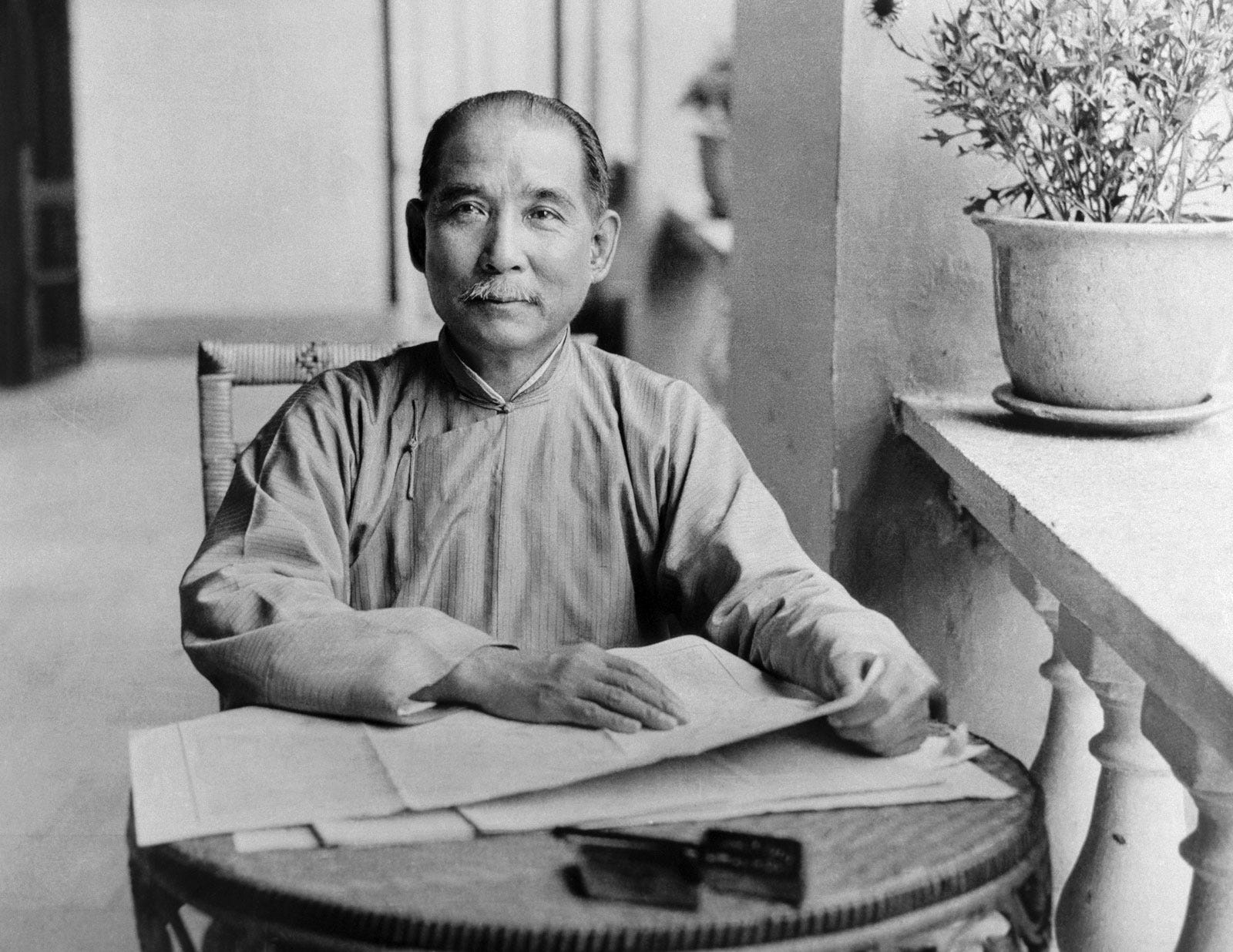
I grew up in America and write for Americans, and my grandfather Liu died in China before I was born. The tumultuous history that he witnessed lies far outside the purview of most Americans—including me. Still, among his tales of obscure warlords, imperial intrigue, and jockeying between Communists and Nationalists, I found some that involved figures famous even in America. One is Dr. Sun Yatsen, known as the Father of Modern China.
My grandfather was a close associate of Dr. Sun. They met around 1900, when both were living in Japan, exiled because of their efforts to overthrow the Qing dynasty. They continued to work together until the very end of Sun Yatsen’s life.
I’ve considered various ways to present my grandfather’s account of his last weeks with Dr. Sun. I recognize that this material [at least in translation] may be a little dry for readers who are not China history mavens. On the other hand, I’m not enough of a historian to paraphrase or contextualize this chaotic moment in history, except to remark that I thought of my grandfather as we were all witnessing the attempted coup in Russia in 2023.
Imagine a time and place where multiple coup attempts occur simultaneously every day, and you get a sense of the world my grandfather had to navigate as he worked to unify and modernize the Republic of China in the midst of the Warlord Era.
In the end, I’ve decided to let my grandfather’s words speak for themselves [I’ve added modern Pinyin versions of some names and places]. He was the witness to this history, not I. So if you’d like a ringside seat at the end of one of the 20th Century’s major historical figures, read on.
The Death of Dr. Sun
In November of 1924, when I heard that Sun Yatsen was soon to arrive back in China from Japan, I returned to Peking [Beijing] and then hurried to Tientsin [Tianjin], where preparations had been made for a Western banquet at the World Hotel for ten-thousand people. Ambassadors from all countries, local dignitaries, and civil and military representatives gathered to welcome Dr. Sun home with great fervor and respect.
Early that morning, the Communist Party had pasted slogans on the streets and distributed flyers in both Peking and Tientsin demanding a greater voice in the nationalist government. The Communist foreign ministers urgently instructed the Tientsin consulates to halt the great reception at the World Hotel. As a compromise, officials were allowed to attend the welcoming ceremony, but any speeches would be blocked.
In the afternoon, Dr. Sun's ship entered the port. He went to his residence to rest and sent a representative to the World Hotel to thank the assembled dignitaries. But Dr. Sun himself was too ill to appear. They all dispersed without any speeches or confrontations.
Quo Taichi [Guo Taiqi, my grandfather’s good friend and later ambassador to Britain and delegate to the UN] and I went to see Dr. Sun, who was lying ill in bed. We reported on the treaty for mutual military assistance between Honan [Henan] and Hupei [Hubei]. And Gen. Hsiao Yaonan's [Xiao Yaonan, Governor of Hubei] representative presented a signed and sealed general agreement laying out the General's desire to establish a national government in Wuhan.
Dr. Sun finished reading the agreement, and smiled. There on his sickbed, he signed his name on the first line and then affixed his seal. On the fourth line, Dr. Sun's son Sun Fo, Quo Taichi, and I all added our signatures.
After signing the general agreement, Dr. Sun told us: "I have heard that the Shansi [Shanxi] and Luoyang troops are planning to attack Kaifeng. If Honan is lost, then Wuhan [a critical port located in central China at the confluence of the Yangtze and Han Rivers] will be in danger. Return and tell Gen. Hsiao that Hupei must send as many rifles, canon, munitions and other military supplies as it can. If Honan Province can be protected, then the entire South can be stabilized.”
He continued, "My illness is serious, and on top of that I have to make a trip to Peking. Although the letters of agreement for establishing a national government have been signed, both sides must maintain the strictest secrecy and proceed stealthily. When I am able to reach Wuhan, then I can announce it publicly. I am sending Quo Taichi to Peking to manage communications with the Hupei side. Liu can return to Wuhan and manage the military assistance from Hupei to Honan. Speed is all-important."
The next day I boarded a train and returned to Hupei to oversee the weapons delivery to Honan. The Hupei Military Representative told me that the Honan warlord Gen. Tuan [Duan Qirui] had secretly backed an offensive against us at Black Boulder Pass, so I traveled to Kaifeng, by the Yellow River, where this war was going to break out.
In January I rushed back to Peking to report the whole situation to Dr. Sun. Early my second morning there, Yu Yu-jen [Yu Youren, another of Sun Yatsen’s trusted protégés during exile in Japan] came to my hotel bearing news that our troops had been badly defeated and had retreated to Chengchow [Zhengzhou]. Before heading the Political Affairs Committee, Yu had been commander of revolutionary forces in the northwest. Now he said, "Each soldier only has one volley of bullets left. Most of their weapons have been seized. We should send an express cable to Hupei asking them to deliver more weapons as soon as possible."
Yu Yu-jen stayed at the hotel for five hours strategizing. Eventually we received the answer from General Hsiao in Hupei: "Five million bullets, several artilleries, rifles, and artillery shells have been sent by special express train to Hsinyang [Xinyang]."
With this cable in hand, we rushed to break the news to Dr. Sun Yatsen, who was undergoing tests at Union Medical College.
Dr. Sun rose from his hospital bed and read the message. Then he said with a smile, "General Hsiao. What a guy! What a guy! This fully proves his loyalty."
After the troops received these new arms, they defeated Tuan’s troops in one battle. Then Dr. Sun ordered us back to Hupei, where we conducted secret strategy sessions with General Hsiao.
But several weeks after our return we received news that Dr. Sun had been diagnosed with terminal liver cancer. We were to bring vials of injections and a famous doctor from Hanyang back to Peking as fast as possible.
We were too late.
In Peking we learned that Dr. Sun had taken three doses of Chinese herbal medicine, including Huangchi [astragalus] and Tangshen [a Chinese herbal treatment for diabetic kidney disease]. After drinking the herb juice, his eyes popped like bull's eyes, and not long after, he passed away.
The Father of the Republic was dead.
— Liu Chengyu, 1946
From Reminiscences at Shih Tsai Tang Study [Shi zai tang shi gao], reprint 1960, translated by Adam Schorr
If you enjoyed peering through this porthole into history, please let me know in the comments below! My grandfather left many more of these rare views, and I’m happy to share them, but only if you’re interested!
Thank you for posting this incredibly detailed piece of history. I didn't know about any of these intricate maneuvers toward the end of his life, nor did I know that he died of liver cancer. I'm very interested in reading more. I revere Dr. Sun for what he had done for China, and how I wish his legacy had lived on in mainland China. What a different world we'd be living in today. Dr. Sun was active in Hong Kong for a period of time when preparing for the revolution, and when I lived in Hong Kong I was acutely aware of his contribution to modern Chinese history.
A fascinating family! And such rich grist for your mill!