

Braiding Drama and Conflict: Why Your Story's Context Matters as Much as Its Plot
'One Battle After Another' is a master class in the "Romeo & Juliet Principle"

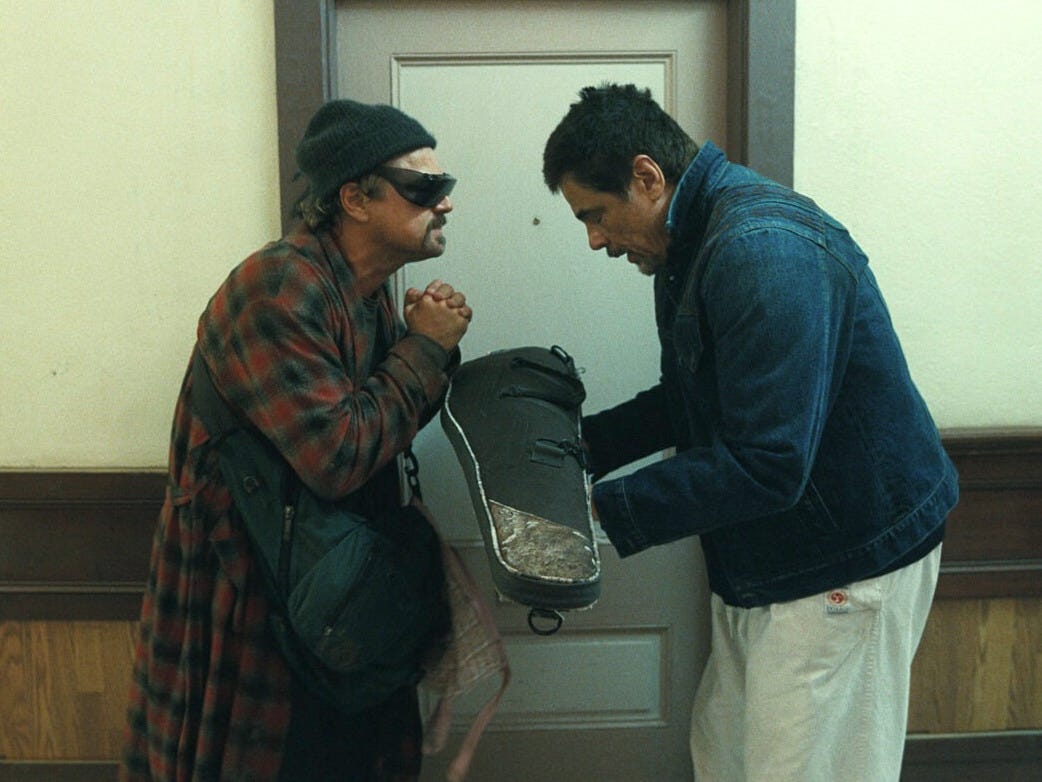
Literature reminds us that no one lives in a vacuum. No matter how isolated or clueless or privileged or blind the characters may seem, their own challenges are inextricably linked to the world that surrounds them. To ignore that linkage is to miss the half of the story that matters most.
Hi Loreates,
I meant to write this a few weeks back, when One Battle After Another was fresh in my mind, but perhaps now more of you will have seen it. Or maybe some of the literalists’ negative reviews have turned you off?
It’s not an easy movie to watch or describe unless you think of it as a satirical comic strip from the 1980s wrapped in the front-page news of 2025. It is precisely that tension/balance between the inner conflict and outer drama that I want to dig into here, because we all need to be cognizant of these two frames in our own work.
This post will expand on the idea that stories have both micro and macro dimensions, often made explicit by primary and secondary story lines, like Romeo & Juliet’s love story within the frame of the Montague & Capulet feud. And beware, there will be spoilers!

Dual Narrative: Conflict inside Drama
No story takes place in a vacuum. However private or personal the conflict at the heart of the plot, there’s always a larger context that directly or indirectly shapes and gives meaning to the characters’ individual struggles. Romeo & Juliet would have had no problem getting married if their families hadn’t been feuding. Dorothy would have been able to go home to Kansas right away, but for the war of witches that dominated the Land of Oz. Harry Potter would have just been another kid wizard in boarding school if the governing Ministry of Magic weren’t under assault from nefarious forces in wizard society.
The drama at the macro level is not always depicted explicitly. Often the larger context is implied by background details and scene-setting or characters who embody the larger dramatic factions and stakes, as explained here:

But the movie One Battle After Another offers a master class in the power of overt dual narratives to make ordinary stories extraordinary. This film, directed by Paul Thomas Anderson and based on Thomas Pynchon’s postmodern novel Vineland (1990), interweaves the core father-daughter love story and the much larger drama of the U.S. military’s war against immigrants and leftist American militants. While the plot involves characters with cartoonish names like Perfidia Beverly Hills and Col. Steven J. Lockjaw, the contextual drama is as deadly serious as the ICE raids throttling Chicago today. The resulting combo feels like a mashup of satires like Kubrick’s Cold War masterpiece “Dr. Strangelove” (whose villain Brig. Gen. Jack D. Ripper may well have been a model for Sean Penn’s over-the-top portrayal of Lockjaw), gritty docudramas like “The Battle of Algiers,” and action thrillers like “Sicario.” This crazy quilt of genres makes the film entertaining, astonishing, and memorably impossible to pigeonhole.
What resonated for me, though, was the dynamic interplay between the dramatic frame of white nationalist militarism in America and the personal frame of conflict between the key characters. The distinction between these frames breaks down like this:
DRAMA requires high macro stakes [tyrannical racist regime waging war against leftists, immigrants, and people of color for control/definition of America]
Drama shapes contextual struggle
Drama won’t necessarily be resolved by the story
CONFLICT requires hard micro choices [a single father must risk everything to save his daughter— even after learning she’s his deadliest enemy’s biological child]
Conflict generates emotional struggle
Story always leads to some resolution of conflict
The management of these two frames is a challenge that every storyteller faces. “One Battle” is rare, though, in the way the plot both switches back and forth between the frames and also turns each frame into an inverted reflection of the other. As a result, the hyper-real military assaults on immigrants ring with outrageous absurdity, and the scenes that otherwise seem to come straight from x-rated comic books resonate with political reality. The way the dual narrative is managed thus winds up integrating the story’s crazy quilt of genres.
There are lessons here for every writer:
1. Macro drama within character
Every character in this movie straddles the line between macro drama and micro conflict. Like Romeo and Juliet, they each nominally belong to one of the factions in the external drama, but not 100%. The main protagonist Pat is a lapsed militant turned druggie who’s traded his revolutionary zeal for paternal devotion to his daughter Willa. His antagonist, Lockjaw, would be the poster boy for white nationalism, but for his sexual fixation on Willa’s mother Perfidia, who is Black.
These contradictions within the characters pull the macro drama inside the micro conflict when Lockjaw’s white nationalist ambitions force him to target Pat and Willa. They also propel the action-packed pursuit, as Lockjaw weaponizes the macro war on immigration for his personal purposes, and Pat plugs back into the resistance movement to help him protect Willa.
In these ways, the story keeps stitching the characters’ personal conflicts through the larger political and military drama. The two frames are thus bound together by the plot.
2. Micro conflict: reflection or contrast?
As an author, you have multiple choices when contemplating your dual narrative. In a standard political thriller, the story’s central conflict mirrors the outer drama; characters act primarily as agents of the fictional world’s larger powers. Also, typically, the tone of the personal plot is consistent with the vibe of the political drama — e.g. Cold War gloom runs throughout almost any John le Carré novel.
“One Battle” is instead distinguished by the zany contrast between its two frames. Lockjaw’s pursuit of Pat and Willa, triggered by the racist membership restrictions of a Christian nationalist secret society called the Christmas Adventurers Club, is patently satirical, and Penn’s scenery-chewing performance insists he’s not to be taken seriously. But the scenery that he chews is terrifyingly realistic — including barbed-wire detention centers filled with migrant families and laborers policed by armed thugs in masks and ICE-like uniforms. That juxtaposition of the comic and the documentary generates sparks of surprise throughout the movie. It’s uncomfortable and confounding and arresting. It’s what makes this film unforgettably meaningful as well as entertaining.
3. Braiding drama and conflict with purpose
Many writers take the outer frame for granted. Maybe the story takes place in a world at war, or in an impoverished neighborhood, or in a country ruled by an evil king. But more likely, we’ll set our stories in the everyday world of our own experience: the suburbs we grew up in, the small town where we live now, the lake or farm or camp were we spent vacations as kids. We might nominally consider the era, the generic values and concerns of the place and time, but our focus as authors will often gravitate to the interpersonal struggles of the characters as if they dwelt on a floating stage. This is true of both fiction and memoir.
Such stories often end up being either melodramatic or vacuous, the characters unwittingly self-involved. The plots may be clever and entertaining, filled with twists and bons mots, but they’re shallow. Readers tend not to remember them, and literary readers will generally pan them, complaining they’re not “about” anything.
If you stripped off the outer dramatic frame of “One Battle,” it, too, would be shallow. The antics and cartoon characters might still be amusing and absurd, but the story would have no depth. The audience might laugh at the over-the-top antics, names, and chase scenes, but they wouldn’t find anything personally relevant in the story. It wouldn’t matter to them. They certainly wouldn’t think it was “about” America today.
It is the connection between the outer drama and the inner conflict that makes any story matter. Whether the outer drama is completely internalized by characters in a bare room (like Raymond Carver’s “Popular Mechanics,” which imbues the two characters with all the drama of the working-class war between the sexes that produced them), or depicted in explicit detail, as in “One Battle,” the meaning of the story is largely defined by the tension between the characters’ struggles and their societal context.
Literature reminds us that no one lives in a vacuum. No matter how isolated or clueless or privileged or blind the characters may seem, their own challenges are inextricably linked to the world that surrounds them. To ignore that linkage is to miss the half of the story that matters most.
Critic Justin Chang seemed to be channeling that idea in his NPR review of “One Battle After Another,” which he called “a gonzo vision of a nation at war with itself and a deeply resonant father-daughter love story... The worst of times really can bring out the best of humanity.”
Loreate Salons for Paid Subscribers are now bimonthly!
By popular demand of our Zoom Loreates, we’re now going to gather online every two months on the third Saturday. All paid subscribers are welcome. As we get to know each other, these gatherings will be less meet-and-greet and more discussion of the thorny issues bedeviling our collective writing life. Consider this online space our Loreate Salon.
Would you like an MFA-level response to your work?
Becoming a Premium Member of the MFA Lore community will entitle you to Aimee’s written feedback on both your query and up to 5 pages (1250 words) of creative work (plus all other benefits of a paid subscription). Your “Take 5 Packet Letter” will highlight both the Strengths and the Opportunities in your work, helping you determine whether it’s time to “press send” to agents or to reorient your revision. Subscribe at the Premium level or upgrade today.
I just watched this movie today, and I knew I had to go back and read your article about it. I've never really thought so much about the outer drama and inner conflict and how they weave in and out of each other until your deep dive here.
Loved the film. Violent and tender, both. A troubling detail about a minor but pivotal character: why did the canny indigenous tracker Avanti sacrifice himself to save the kid? … the father-daughter reunion near the end hinged on the Native American’s decision to take on four or five armed men in that 1776 group. We did witness Avanti hunt down an activist for the Christmas Adventurers, seen by two kids he doesn’t threaten. And he “doesn’t do kids,” but it was a big leap from those two clues to his dying full of bullet holes in the doorway. Was this a cartoonish nod to Uncas in The Last of the Mohicans? (Played by the same actor, Eric Schweig.) At least that suicidal lunge at the bad guys was believable. I’d have thought Avanti would go all in but with stealth. Hmmm …