

Epistolary: Why Compose in Correspondence?
'The Correspondent' reminds us that mail can be a vibrant narrative device


It was just one of these things where I started this exercise of letters. The writing of a long literary novel is such a heavy, dense process. It can feel very stodgy or like a sort of plodding through the story. So, there was something that felt very light about writing the book in letters. The form felt so different and it felt—if not easier—lighter, I guess.
—Virginia Evans, on writing The Correspondent
Hello Loreates,
Today’s post serves two purposes.
First, may it encourage you to read and ponder Virginia Evans’s wonderful epistolary novel The Correspondent, if you haven’t already. [DO listen to the audio version, if you can! It’s masterful.]
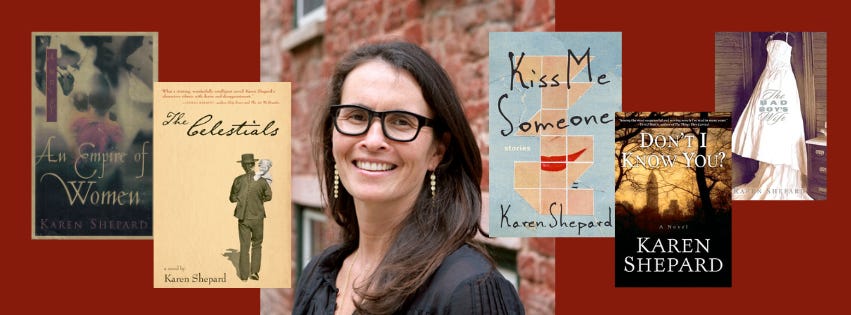
And second, this post is prep and encouragement for you to tune in to my conversation next week with novelist and essayist Karen Shepard about her extraordinary epistolary essay “The World Is An Easier Place Without You In It” in The Paris Review and the nexus between her mixed-race Eurasian family and her writing more generally. Link to reserve/join below.
If you’ve ever wondered about the pros and cons of using correspondence as a narrative device yourself, please read on.
Aimee
Save the Date!
Tuesday, May 12, at noon PT
Well Published, Live! with Karen Shepard on her Paris Review publication and writing about mixed-race families
I’m delighted to invite you to my next Well Published, Live! with novelist and essayist Karen Shepard. We’ll be chatting about her latest publication — an epistolary essay!—in The Paris Review and about the challenge of writing mixed-race stories.

Some Why’s and How’s of Writing in Letters
Epistolary: written in the form of a series of letters
Formed from the noun epistle, which refers to a composition written in the form of a letter to a particular person or group. In its original sense, epistle refers to one of the 21 letters (such as those from the apostle Paul) found in the New Testament.
Epistolary writing is in vogue again. This happens every few years when a book-in-letters tops the bestseller list. Here are just a few epistolary titles from the past that you’ll recognize:
84 Charing Cross Road
A Woman of Independent Means
The Color Purple
Possession
The Stone Diaries [not entirely, but largely epistolary]
The Guernsey Literary and Potato Peel Pie Society
We Need to Talk About Kevin
Beautiful World,
Where’d You Go, Bernadette?
The latest epistolary hit is The Correspondent, by Virginia Evans. This novel-in-notes was released a year ago last April and gradually picked up readers all summer until its “slow burn” fans propelled it to the top of the New York Times hardcover best-seller list in December. Since Evans had seven failed books in the drawer, it seems fair to wonder if there was something about the form that gave her “debut” its charm.
In interviews, Evans has described the book as an “exercise of letters” that she practiced between projects, only to realize that this exercise was producing something deeper and truer than she’d realized. That describes the ideal experience of reading an epistolary story, too: it can feel more authentic and direct than other narratives. At the same time, as Evans says, the form feels “lighter,” less demanding, than a typical novel. But why is that the case, and how does an author pull off this exercise?
Additional questions occurred to me as I read Karen Shepard’s recent epistolary essay encircling her mother’s planned suicide, “The World Is An Easier Place Without You In It” in The Paris Review . I’ve been wrestling with my late father’s archives for years, struggling to shape a collection of essays out of the artifacts and my interstitial commentary. How, I wondered, did Karen decide to rely exclusively on correspondence, which specific pieces to include in her essay, how to cut and arrange them, how to balance the arresting and the mundane in a way that reflected the ordinary nature of letters and emails and texts while also shaping the arc of a meaningful story?
I’ll ask Karen all those questions when we chat next week, but with her essay and The Correspondent rolling around in my head, I thought I’d use this space to sort out my own thoughts as a reader and sometime writer of epistolary prose.
