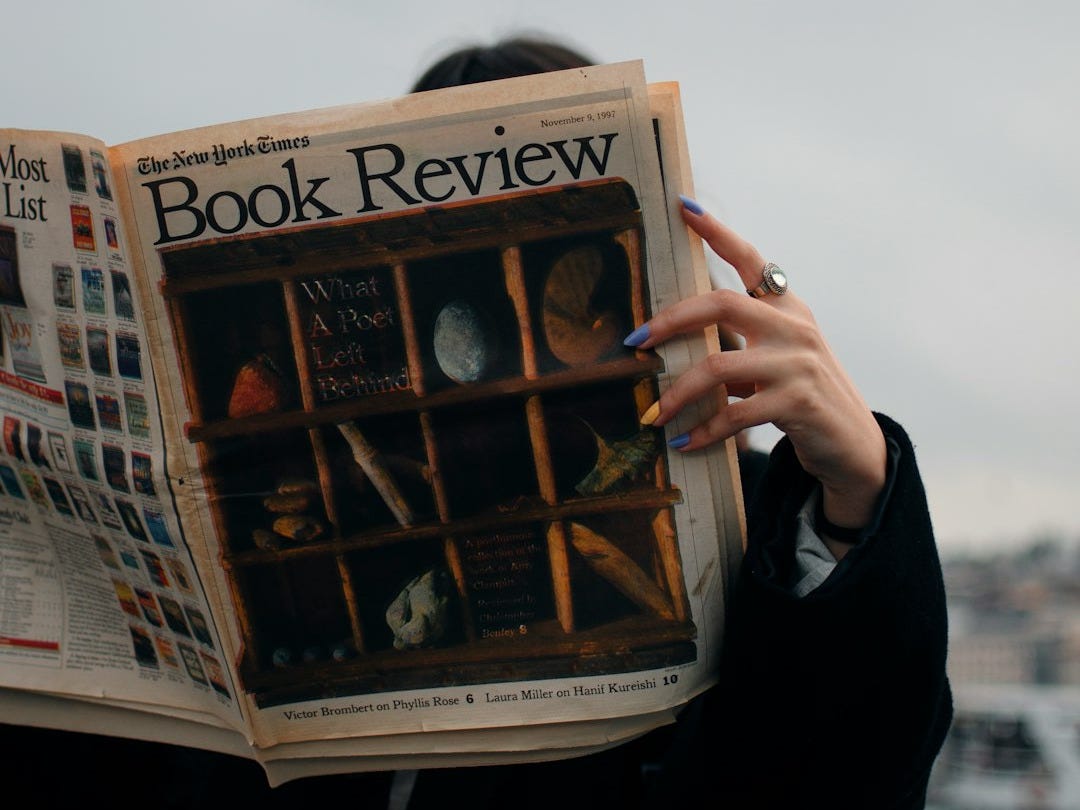
How to Write a Book Review
Rahna Reiko Rizzuto straddles the line between author and critic
In a writer I do not know and had never read before, I had discovered an echo, a shared vision, a kindred spirit in a broken world.
Welcome to Writer In The World, the Wednesday section of Aimee Liu’s MFA Lore. This curated collection of reclaimed essays on the writing life and new videos of Writers in Conversation is produced by MFA faculty and alumni.
Aimee’s MFA Core essays on the craft and business of creative writing will drop each Saturday. And her free Metaphortography Writing Prompts post every other Monday.
As an MFA Lore subscriber you can join our community and elect to receive some or all of these sections each week.
Reiko Writes a Book Review*
by Rahna Reiko Rizzuto
Recently, I was asked to write a book review. I said yes.
As a reader, I don’t generally read book reviews because I don’t want other people’s opinions messing up the story. I want the mystery; I want to see each of the author’s decisions, and how she builds her world and her plot. For me, the ending of a story begins in the first sentence, and I don’t want anyone but the author herself taking me down that path. Others I am happy to hear from only after I am done.
As a writer, though, I want everyone to read book reviews. I want lots of reviews written, especially reviews of my own books. Reviews are the keys to success. How many outlets reviewed your book, where they appeared, what they said: all of these measure the value of your book, and therefore your own value as an author and a person.
Except when they don’t. My first novel was reviewed in every major outlet and largely very positively. My second book got exactly one review, and it wasn’t very good. It made no difference to sales, or success, and frankly no difference to my life.
At the AWP conference in Portland, I attended a panel on the Future of Criticism, moderated by Kate Tuttle, with Jane Ciabattari, Ismail Muhammad, Hope Wabuke, and Oscar Villalon, where one of the main issues was whether there was any value in publishing a bad review. Or, translated into my own burning question as a very occasional reviewer, “What if I don’t like the book?” When you aren’t a professional critic celebrated for your wit and insight, it hardly makes sense to come out of obscurity to trash someone else’s book.
In his article, “Like This or Die,” published in Harpers, Christian Lorentzen laments the loss of analysis and evaluation in favor of “gush” and celebration: digestible consumerist book coverage that drives web traffic. He decries the “dreary formula” that hinges on “generic adjectives of praise.” Compelling, engrossing, charming…are these false acquiescences to authors and publishers? They might be. Even those of us who say they never read their own reviews have someone in the publicity pipeline scanning each mention for that pullout quote to blast out.
The consensus at AWP, at least what I got before I had to run out to prepare for my own reading, was that books are news, and as such the measure of a review is not good or bad, but relevant and appropriate. It is refreshing (and somewhat terrifying that it does strike me as refreshing) to think that a book is not (just) a product, and a review is not an advertisement to sell it, but that a book is a new creation in the world, just as is a building or a company or a law or a report on an investigation two years in the making, and that the review might be both an announcement of its emergence and a thoughtful assessment of the ways in which it contributes to our ideas about ourselves and our society.
It took me close to a month to write my review, which clocks in at something like 1500 words – not a particularly lucrative way to make a living. I could have written faster, but I was thinking. There were moments I particularly liked; aspects that were not to my taste but might be to other readers. Through the lens of “news,” did my particular predilections really matter? There were also things I learned, which got me wondering about research and accuracy and who gets to tell a story, and I also wondered (and wanted to ask the panel at AWP but did not get the chance) about the reviewer’s responsibility to be an expert on a topic. What if the author got something wrong and I did not catch it? What if the author got the facts right but was taking an unusual stance on them, and I was missing the nuance and implications of that vision?
Over the course of weeks, whenever I thought about the novel, I kept bumping up on me. What it got me thinking about, even if, perhaps, that was not the author’s intention. Or perhaps it was? The issues I could not shake seemed quite prominent in the text, but was that just because I looking for them? I was excavating an aspect of the human condition that was certainly on the page, but were these so central to the author that she would have wanted me to focus my review there? (It wasn’t exactly how her publicity materials were pitching it.) Did that matter? As a writer, an editor, a teacher, I believe that the work can and should speak for itself, but should I be reading her other books (let’s recall that book reviewing does not a living make) to see how her subjects and themes echoed or evolved over her career? Should I find out if she had contradicted my reading of her work in old interviews, or worse, if she was on record repeating exactly my point over and over again?
In the end, I did some basic spot-checking on her history (though this particular author has a very good reputation for immersing herself in her research) and did not delve further. I wrote about the effect that her novel had on me; how it extended my thoughts on issues that were already on my mind – why we feel it necessary to qualify fiction via descriptors like women’s for example. I wrote about the many phases of war in the novel, how it was background and foreground, and how hate and violence are manufactured. I praised the author’s skill at doing something that I also strive to do in my own work: personalizing a sweeping historical event – indiscriminate and wholescale slaughter for example – by embedding it into a single person’s body. A person you might know; a character you might already have fallen in love with.
I didn’t write about myself or my own work. I’m not that kind of critic. Though I did think of my life, and my experiences. And in particular, I thought about Hiroshima, and how the full human impact of the murder of hundreds of thousands of people only truly hit me when I began to hear stories of a dying sister calling out in the night, or finding a mother’s bones. That a novel that had nothing to do with me or Hiroshima could remind me of that moment; that this author was also using women and children to help readers access events that their minds would otherwise fight to distance themselves from; this was what I needed to write about. In a writer I do not know and had never read before, I had discovered an echo, a shared vision, a kindred spirit in a broken world.
Rahna Reiko Rizzuto was born in Hawai’i and grew up in a small “cow town” on the Big Island. Her novel about the Japanese American incarceration camps, Why She Left Us, won an American Book Award in 2000. It also received a Gustavus Myers Outstanding Book Award Honorable Mention, and was named one of the Best Books of 1999 by the Honolulu Advertiser. In 2001, Reiko was awarded a US/Japan Creative Artist Fellowship, funded by the National Endowment for the Arts. She spent eight months living in Hiroshima, Japan to research her second and third novels. While she was there, she also began working on a book that is was inspired by her experience of living at the original Ground Zero and interviewing the atomic bomb survivors as the September 11th attacks unfolded within sight of her Brooklyn-based family. This book, Hiroshima in the Morning, was published in 2010 by the Feminist Press. It was named a National Book Critics Circle Award Finalist, an Asian American Literary Award Finalist, a Dayton Literary Peace Prize Nominee, and the winner of the Grub Street National Book Award in Nonfiction. Reiko’s third book, Shadow Child, tells the story that she went to Japan to research. It is a mystery, a family saga, and historical fiction, told from the perspective of three strong women, bookended by two crimes. It was published by Grand Central Publishing in 2018, the third and final book in what she considers to be an informal triptych on the Japanese American experience during World War II.
Reiko will be leading a creativity workshop in June on the former Goddard campus with MFA faculty colleagues Elena Georgiou and Sherri L Smith. Have a look!


I've written a few reviews. I find them challenging but I'm about to start on one on a book, nonfiction, that isn't recent but I hope will have some interest. This was interesting and helpful.