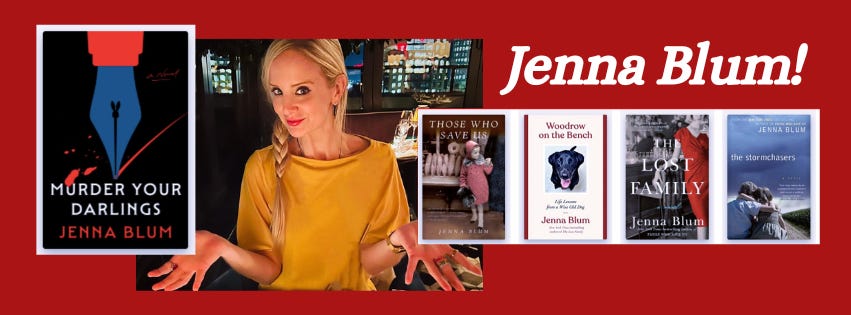
Bestselling Supernova Jenna Blum on Her New Send-up of the Book World: 'Murder Your Darlings'!
Jenna talks about switching genres, turning the book industry inside-out, writing funny sex, and exercising her true voice
“I gave myself permission to use my own voice, which includes–I hope!--being funny. There’s nothing I love more in the world than making people laugh.”
Hello Loreates!
This week, I was delighted to have the chance to ask bestselling supernova Jenna Blum a few questions about her latest novel, Murder Your Darlings. This tongue-in-cheek thriller came out in January from HarperCollins, and it marks a genre change for Jenna, since most of her previous fiction was historical. So I had lots of questions. And she was most generous — and, of course, funny —in her answers about the book, her writing process, frustrations, and epiphanies during the creation of this novel.
Jenna is the New York Times and # 1 internationally bestselling author of novels Those Who Save Us, The Stormchasers, and The Lost Family; memoir Woodrow on the Bench; audiocourse “The Author at Work: The Art of Writing Fiction” and WWII podcast The Key of Love. Murder Your Darlings is Jenna’s fifth book and first psychological thriller.
As CEO of the online author interview company A Mighty Blaze, which she cofounded with CarolineLeavittville during the Covid-19 pandemic, Jenna earned a reputation as a publishing industry community builder and innovator. As on-air host, she has conducted hundreds of interviews for the Blaze, from literary legends to new voices. Now it’s her turn to be interviewed!
Do read on!
Aimee
Save the Date!
Tuesday, June 2, at 10am PT
Well Published, Live! with novelist Julie Buntin on her new book ‘Famous Men
You are invited to my next Well Published, Live! with novelist Julie Buntin, whose new novel, Famous Men, is forthcoming from Random House in July. Her debut, Marlena, was a finalist for the National Book Critics Circle’s John Leonard Prize and longlisted for the Center for Fiction’s First Novel Prize.
Murder Your Darlings!
Q&A with Jenna Blum
“The meta-ness was part of the nudge-wink fun.”"
Q: Your first three novels were historical, and most of your fiction has related to World War II and the Holocaust. Your last book was a memoir about losing your beloved dog Woodrow. So what gives with the switch to a comedic thriller?
A: I love this description of Darlings…! And yes, although I hope all of my previous books have what Stephen King called “The I-Gotta” structure–”I gotta stay up until I find out how this book ends”--which a thriller MUST have, Darlings is definitely a different flavor. My previous topics were not exactly a laugh a minute.
Why the pivot? I was working obediently away on an historical novel my agent and editor loved and…it was awful. I’d write every scene (as my protagonist in Darlings, Sam Vetiver, does in Chapter 3), then back out thinking: What was the point again? Meanwhile, the idea of this book about murderous writers was sneaking up the back stairs of my mind, and one day, I read Jean Hanff Korelitz’s novel The Plot, which is a thriller about the publishing industry, and I thought: Hey, wait a minute. I got Jean’s number from a mutual friend and called her to ask: did she get pushback when she switched from writing “literary” fiction to thrillers? Jean said, “I just write what I want and other people market it. You should write what you want.” Fine–I decided to write Darlings and if it went badly blame it on Jean Hanff Korelitz.
When I had 100 pages, I sent them to my agent and waited an agonizing week while she read. She called me and said, “You know, Zhenna–” (like Sam’s agent Mireille in Darlings, my agent is French) –”I think this is the smartest thing you’ve ever done. Because it’s the first time in 25 years of working together that I‘ve heard you use your own voice.”
I loved writing every word of this book.
Q: The title of this new novel, Murder Your Darlings, makes a pun out of the advice from British writer Sir Arthur Quiller-Couch, in his 1916 book, On the Art of Writing:
“Whenever you feel an impulse to perpetrate a piece of exceptionally fine writing, obey it — whole-heartedly — and delete it before sending your manuscript to press. Murder your darlings.”
It’s often misquoted as “kill your darlings” and misattributed to Faulkner – all of which you use as fodder for sparring between characters in the novel!
I won’t divulge the many ways this phrase plays out in the plot, but suffice it to say, it’s central! Did you begin the project with this title, or did it rise up out of a later draft?
A: This was always the title–except originally it was the PURLOINED “Kill Your Darlings”! Truth be told, that was going to be the title until my agent informed me, amid a shower of my F-bombs, that a writer from my own publishing house was coming out with a book called Kill Your Darlings a few months before mine. We kicked around a bunch of other titles, and when I looked up Murder Your Darlings, I realized that this was the OG saying and Kill Your Darlings was an appropriation…which considering that the book is about the ultimate form of appropriation, murder, was, well, appropriate! I love my title.
Q: There’s a lot of tender humor in your earlier books, but this one is a murderous lark. Although there are some serious issues woven throughout, it feels like it was written for sexy fun– both your own and the reader’s. How did you stop taking yourself seriously and let your guard down enough to write funny and with lots of sex?
A: Oh, I’m SO glad you think Darlings is funny! I do too. I snort-laughed my way through Every. Single. Scene. But you know how it is: you don’t want to be the only person sitting in a room in her yoga pants thinking her book is hilarious, then getting out there to hear…crickets.
All my books have had lots of sex in them. (Although Darlings is admittedly Five-Chili-Pepper spicy!) The characters in this one are just wearing different clothes. Or lack thereof.
And when I switched genres to writing something really contemporary, I gave myself permission to use my own voice, which includes–I hope!--being funny. There’s nothing I love more in the world than making people laugh. (Except maybe my dog. Who also makes people laugh.)
Q: Speaking of taking things seriously, one of the aspects of the book world that you lampoon is the degree to which writers take themselves and their work seriously enough to die – or kill - for. The novel does a number both on the deadly serious business of MFA and other writing programs, and also on the to-die-for competition for commercial success among established authors. Do you think writers would be better off if we lightened up across the board?
A: Ha ha, no. I don’t think it’s possible. Good writing requires passion, which doesn’t couple well with laissez-faire. Not that I’m advocating killing people or slicing through your colleagues’ Achilles heels. My personal and professional life are founded on the idea that the rising tide lifts all boats, and I’ve dedicated myself to nurturing and growing literary community. But a writer who takes it easy? Yuck. Nope. (Literally when I see men on dating apps say “I’m looking for somebody who doesn’t take life or herself too seriously,” I’m like NEXT!)
Q: Simone “Sam” Vetiver, your protagonist, is a dead ringer for you, Jenna Blum. Which means that you’re both describing yourself physically to a T and at least appearing to expose your innermost vulnerabilities and quirks, while simultaneously making fun of yourself. What prompted you to make Sam such an overtly obvious doppelganger for yourself?
A: Oh yeah, Sam is 1000% me. Let’s just get that out of the way. The things that happen to Sam in the novel have not happened to me, or I’d be in much worse shape. But she is otherwise so me, from her career EKG to her writing process to her love of touring to her Dress Like a Book Cover red dresses and the cheeseburgers she eats from room service after an event–not to mention her writing workshop, agent, and editor–that one day I was doing a podcast for the novel and the interviewer looked over my shoulder and said, “Isn’t that Sam Vetiver’s fireplace?” And I thought: Right, I forgot I put my apartment in the book.
It was a joy to write about myself and my own life, honestly. I mean, what would be the point of a writer writing about a writer who wasn’t her? The meta-ness was part of the nudge-wink fun. And I love my writing life— the ups, downs, miracles, uncertainties, and fears. Well, maybe not the fear and uncertainty parts, but they go with the territory. I have been so privileged and blessed to be a writer my whole life, and despite the very real difficulties, I intended Darlings to be a love letter to this existence, to lay it all out on the table for readers and say, “Look, this is what it’s really like. Enjoy!”
Q: The story is told by alternating POV narrators, all speaking in 1st person, and none of them reliable witnesses or confidantes. One is slyly named “the Rabbit,” with mystery identity and motives. How did you arrive at this circular narrative device?
A: I love the way you put this–that I “arrived” at the device. People often ask how I chose to include three narrators, and in fact I did not! The novel was supposed to be all Sam, originally. I knew she would fall in love with a male novelist who had multiple stalkers and that her subsequent stalking of them would turn her into somebody she didn’t like.
What I didn’t anticipate was that about halfway through Part I, I’d be lying on my couch feeling sorry for myself the way writers sometimes do, and suddenly I thought: What if one of the stalkers had a voice? I got up and went into my study and wrote what became the Darlings prologue, and it was like sticking my hands into an electrical socket. That was the Rabbit.
So fine, I thought; I’ll have two narrators: Sam will do things and the Rabbit will comment on them, and I’ll striate the story like that. I love those Rashomon stories, like The Affair on Showtime, so I loved that idea. And the Rabbit’s first-person voice, which is SO not mine, was so clear and accessible that every time I sat down to write her, I thought: Oh, thank God it’s a Rabbit day.
What I did not anticipate again was getting to Part II and having William pop in to say, “GREETINGS AND ADORATIONS, IT IS I, WILLIAM CORWYN!, here to tell you what my female counterparts cannot: THE TRUTH.” And I thought, Oh Jesus, William wants to take the whole second act of the novel. And….he did.
Q: You skewer so many aspects of the book industry, from the dynamics of writing workshops, to author-agent relationships, to the realities of book touring, to the love-hate interactions between authors and fans, to the economics of life as a published author. How did you organize all these spotlights? Did you use a master bulletin board to figure out which industry beat to match with which plot beat? And which of these industry scenes was the most fun to write?
A: Thank you! I really wanted Darlings to be the one-stop shop for all things writer life. I did use an outline, I always do, but it featured only the plot of the book: what happens to Sam, the Rabbit stalking, what William is doing behind the scenes. I used only story plot in my outline, in other words. Because the book is about writers, all elements of writing life fit neatly into the story.
I loved writing SO many of these scenes. Writing the MFA program scenes was a relief, since I’d been carrying that subset of feelings and experiences around since my own grad school days. And the Rabbit as a bookseller, since I once worked at a Borders. I think my favorite writing-life scene, though, is when William goes to the publishing house, Hercules (which is actually HarperCollins), to meet with his editor, whose office is next door to Sam’s editor. I cannot get through that scene (as with so many William scenes) without crying with laughter.
Q: Satire doesn’t always sit well with thin-skinned subjects. Did your “revelations” ruffle the feathers of anyone in your real-life publishing world?
A: Not at all, thank God. I was a little worried about it in the aftermath of writing (during the writing, as always, I was cloaked in a sort of merciful amnesia, my #1 obligation being to the story and the characters). But after I pushed away from the desk and handed the book in, I thought: Oh yeah, I did put my agent and editor in there. (And my writing workshop–the Cocktail of Novelists. And my MFA buddies. And my publisher. And readers and libraries etc etc etc.) Luckily, my friends–who all chose their own character names–thought this was a lark, and my agent and editor, who now refer to themselves as “Mireille” and “Patricia,” their Darlings alter-egos, argue about who is more important in Sam/ Jenna’s life: the agent or the editor.
Q: This plot revolves around the issue of intellectual property theft. It doesn’t broach AI theft, but it certainly does inject enough money into the plot that readers can see how certain authors might steal ideas or outright plagiarize to “make a killing.” Your villain pretends to write for the love of it, but that’s just an act. Is this conniving character based on anyone you’ve ever met? Do you share my fear that this motive is looming larger and larger over literature as AI makes it easier and easier to cheat?
A: Ha, what a great question. That’s probably the ONLY writer-life thing I didn’t tackle in Darlings: AI theft!
I will push back gently and say the villain does indeed have a very real love of writing–all the characters in Darlings do. (Which is probably what makes them so dangerous.) I never met IRL a writer prepared to go to such lengths as to steal outright–via AI or not–at least, not that I know of! I do think every writer now has to grapple with his or her own conscience to figure out what he or she will tolerate in terms of AI use, what’s the Rubicon. Myself, I will not use it. It’s like sending yourself to extinction and bringing your species with you. Anthropic stole my books. Andi Bartz is my hero.
Q: Where do you go from here, Jenna? Are you heading back to historical fiction? Writing another memoir? Or, are funny sexy thrillers your new jam?
A: Great question. The only sure thing I can say here is: no more memoir! Not because I have anything against the genre–I love reading them–but because I never intended to write one in the first place, and if I hadn’t loved my old dog Woodrow so much that I had to honor him in writing, I wouldn’t have. (Woman plans, God laughs: I’m sure I’ll be out with a memoir next week.)
I have two thrillers and a historical novel rolling around in my head like marbles right now, and I plan to spend the summer developing them and seeing which disappear into the mouseholes in my brain and which one remains. I will say that the historical will be written like a thriller. And I hope to NEVER write anything again that isn’t sexy and funny! Thank you for saying that.
Q: Finally, In a few weeks (September 1!) as part of my Well Published, Live series, I’m going to be interviewing you and your co-conspirator Caroline Leavitt about your spectacular creation A Mighty Blaze, and especially about plans for the Blaze Substack. Do you want to say a few words about the role that A Might Blaze plays in your life these days?
A: The Blaze!!! A Mighty Blaze, which has put authors on-camera since March 2020 to feature their new books for our beloved readers, has been a chief joy of my life since Caroline and I joined forces to ignite it at the beginning of Covid. (Yeah, my life is all about the fire metaphors.) And Blaze is blazing right along, with 1500+ interviews, five different genre shows, a newsletter, a podcast, and yes, a new Substack! Some of the irons in the Blaze fire include a national book club, a Coming of Rage show, and a show for speculative/ dystopian fiction. Stay tuned!
It has sometimes been a challenge to balance my Blaze life with my writer life. But I do a lot of author interviews myself–for Friday Frontliner, which is for high-visibility career authors–and whether I’m on camera or producing behind the scenes, the Blaze reminds me for a few blessed hours a week of what’s most important: it sinks a deep taproot down past the marketing and business noise into the writing. What could be better for writers –and readers– than that?
Would you like MFA-level feedback on your work?
Benefits of a Premium Subscription to MFA Lore include membership in the Take 5 MFA Lore community. This will entitle you to:
Written feedback on both your query and up to 5 pages (1250 words) of creative work, plus an optional follow-up phone call. Your “Take 5 Packet Letter” will highlight both the Strengths and the Opportunities in your work, helping you determine whether it’s time to “press send” to agents or to reorient your revision.
Our exclusive monthly zoom writing workshop, just for Premium Take 5 Loreates.
Full access to paid posts and MFA Lore archives, and all other benefits of a paid subscription.
Subscribe at the Premium level or upgrade today. Details HERE: