

Need a Little Tenderness in Your Writing? Let Music Open the Floodgates
Tune memory can crack even hardened shells around feeling

“Familiar music acts as a sort of Proustian mnemonic, eliciting emotions and associations that had been long forgotten.” — Oliver Sacks
This one’s personal!
Have you ever found yourself home alone, tears streaming and mind spinning with revealed truths that you’ve been seeking in your writing for years? That was me the other day. And the catalyst was music.
Afterward, I thought of the research I’ve read about the power of music to unlock memory, emotion, and meaning. And I realized the connection between music and writing, especially for memoir writers, deserved more of my attention.
So here’s my story and my understanding of what happened to me and why my experience might be worth your attention, too.
Read on!
Aimee

If You’ve Walled Off Your Emotions, Let Music Set Them Free
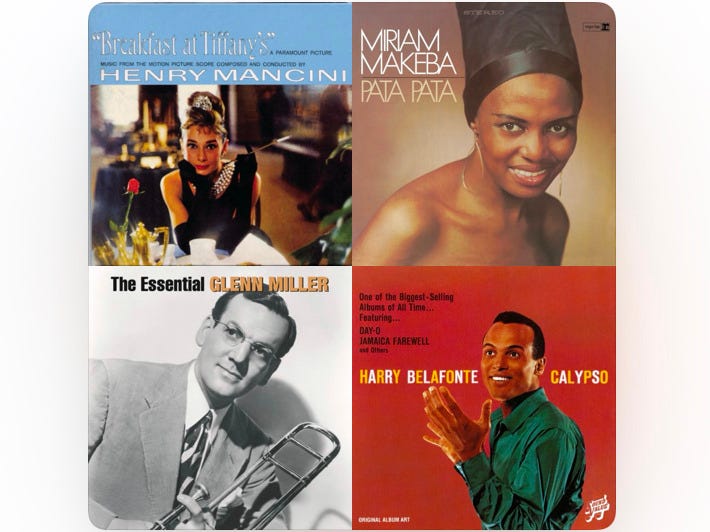
Some people can write with music playing in the background. Not me. Some households are filled with music all the time, but not mine. If anything’s playing in the background at ours, it’s usually the news. This week I started listening to an old playlist, and a few minutes later I sank, weeping, into an emotional puddle where I remained for the duration of a dozen songs by:
Henry Mancini
Miriam Makeba
Harry Belafonte
Mozart
Glenn Miller
Vivaldi
Ella Fitzgerald
More Henry Mancini
It was Mancini’s “Two for the Road” that took me down, as it always does to a greater or lesser degree. The chords and changes mirror the melancholy in the 1967 Stanley Donen movie of the same name, with Audrey Hepburn and Albert Finney playing a couple who’ve lost the tenderness that once made them mad for each other. I was fourteen and already a confirmed devotee of Audrey Hepburn when the movie came out. I felt the universality of this story of neglected love. I saw my parents in it, and my own future romances. The sweet sorrow in the music confirmed all these associations.
Now, though, the resonance was amplified by an essay I’m writing about my relationship with my mother. It was a hard relationship, so marked by emotional whiplash that I built a nearly lifelong shell against feeling too much for her. But she was the one who first loved every artist on the list above. She was the one who taught me to embrace stories and art, to read a painting and to swoon at certain kinds of light. My essay honored that appreciation, but my writing group confirmed that it lacked tenderness. The tenderness that had made me mad for her as a child but that I’d lost in adolescence and never reclaimed.
“Two for the Road” gave me sudden access to that lapsed feeling. But that’s not all. As the tracks shifted and “Moon River” began to play, I realized that my identification with my mother went far deeper than I’d ever admitted before.
“Moon River” was Mancini’s theme song for “Breakfast at Tiffany’s,” the movie that first anchored Audrey Hepburn in my psyche. As a teenager I adopted her character Holly Golightly as my alter ego: I longed to live in Manhattan as a “wild thing,” daring to explore society, high and low, maintaining an exquisite balance between tender vulnerability and invincibility. After college, I fashioned and lived my own version of Holly Golightly over four years in New York— until I could no longer bear the loneliness that accompanied her untenable balance.
Only decades later did it occur to me to wonder how this film had lodged so deeply in my sense of self, given that I was only eight years old when it was released. I can’t remember the first time I saw the movie, though I know every scene by heart (yes, including the cringe-worthy Mickey Rooney in yellowface). I memorized every song on the album we played on the living room stereo. I made this movie — and Audrey Hepburn — my own as a teenager by emulating her style and starving myself to match her figure. It’s not an overstatement to say that I adored her then as I could not adore my mother. Yes, transference.
But here’s the thing. My mother must have been the one who introduced me to Audrey Hepburn, who took me to her movies and purchased the soundtrack albums. My mother in her youth looked more like Audrey than I ever could. She loved to tell stories about her early years of marriage in Greenwich Village, where she was living when Hepburn debuted on Broadway as Gigi. And years before “Breakfast at Tiffany’s,” Mom would have inhaled “Roman Holiday,” “Sabrina,” and “Funny Face.” In personality, my mother more closely resembled Kate than Audrey Hepburn, yet her whole adult life she wore her chestnut hair in the same French twist that Audrey made iconic in her signature scene, window shopping alone at dawn in evening dress at Tiffany’s.
I once interviewed a woman who recalled being deathly sick at the start of each school year until therapy revealed that her mother had found her father’s body on the first day of school when she was a child. The mother had transferred her remembered dread to her daughter without either of them realizing it.
Now, in my living room more than sixty years after I heard “Moon River” for the first time, I understood that the ache and yearning unleashed by this song belonged not only to me but, first, to my mother. What I’d always felt when watching this film or listening to the soundtrack was a longing for freedom and individuality that my mother, for various reasons, could not grant herself— but imagined experiencing through me.
And then, as I recalled my mother swaying and smiling to the clicks of Miriam Makeba’s “Pata Pata” or growing glassy eyed over Belafonte’s “Try to Remember,” I understood that her truest and most complicated gift to me was her yearning.
I got up and made a list, then, of all that she had taught me to yearn for: art, independence, natural wonder, literature, laughter, intelligence, style, adventure, scintillating conversation, riveting stories, and, yes, gorgeous music.
The tension between us had grown over her insistent attempts to control my expressions of these yearnings, especially the contents of my books. When my version of freedom contradicted her expectations, she’d react with emotional daggers. The resulting roller coaster made me alternately embrace and reject the cravings that I’d absorbed from her. But they shaped me as an artist and deepened my soul.
Witness my cathartic response to the music she loved. I was crying for her, with her, both. This, then, was the missing source of tenderness for my essay: more than anything else, she taught me the power and beauty of yearning.
