

The MindMelding Art of Interiority on the Page
How to represent thought in narrative: lessons from Sally Rooney

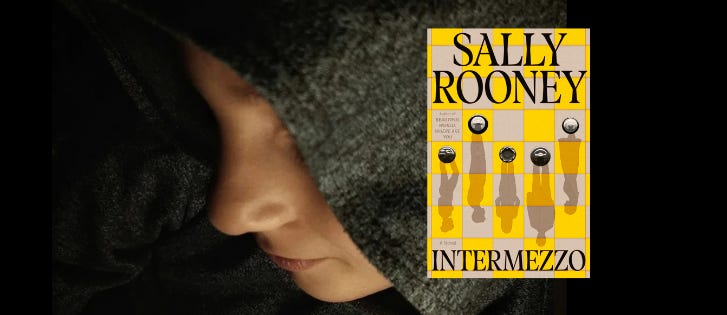
Interiority is like literary sleight of mind. The thoughts reported on the page must be carefully crafted to appear spontaneous and resemble actual thoughts, but transcripts they are not.
Hello Loreates,
The wars continue. We continue. Somehow even amid the atrocities, spring blooms. As of this week I have two new grand babies, and I’m trying to hold onto the joy and hope of their beginnings, just 4 weeks apart, in the thick of now.
I’m also trying to begin a couple of new writing projects, which feel as tentative and speculative as embryos themselves. One of them could lean heavily on interiority, which came up in our recent Take-5 workshop, as well. And since I just finished reading Sally Rooney’s extraordinarily interior novel Intermezzo, I thought I’d use this post to take a deep dive into interiority by annotating some key aspects of Rooney’s approach. For my own benefit and yours.
Thanks for taking this ride with me!
Aimee
If you’re not sure what an MFA annotation is, read this:


Special offer!
Powerful writing is a form of resistance. That’s why I’m offering a year of MFA Lore paid subscriber benefits for just $30. Become a stronger writer and use your words to save the world:
Writing the slippery, silent mind out loud
One of the greatest magic acts in creative writing is the mind-melding feat of “interiority.” In simple terms, this means that the author slips into the mind of the character (or self in a memoir) and creates the illusion of their thoughts on the page. Interiority allows the reader, too, to get inside the character’s head — or rather, to feel as if they’re inside the character’s head.
As with all magic acts, that distinction is crucial: the goal is to make the audience feel something that’s not actually happening. Interiority is like literary sleight of mind. The thoughts reported on the page must be carefully crafted to appear spontaneous and resemble actual thoughts, but transcripts they are not.
Interiority can take the form of a quick internal aside, an excursion in free indirect style, or a longer section— even a whole book — in stream of consciousness.

But like any magic act, interiority looks a whole lot easier than it is to pull off well. Not only do you need to know a character’s voice inside-out before you can write their thoughts, but you need to know when, how, and why they mentally lie to themselves. what their misconceptions are, what they’re selling and what they’re avoiding. You also need to manage technical challenges like infusing thought with telling details and transitioning in and out of interior perspectives.
Sally Rooney’s 2024 novel Intermezzo leans so heavily on interiority that it’s basically a master class in this technique. One way or another, the bulk of the book is written in prose that mirrors the words, images, and ideas flitting through the characters’ minds. Things do happen. Characters do speak. The POV occasionally pulls back to middle-distant 3rd. But most descriptions are embedded in mental wanderings. And many of the interior passages go on for pages. This infuses the whole narrative with intense subjectivity, which shifts from character to character as the baton of POV is passed around the cast.
Few authors would choose to rely this heavily on interiority for an entire novel. But it serves this particular story, which focuses on the ways self-consciousness warps morality and distorts self awareness. And Rooney’s technique in this book is worth studying because almost all of us will want to employ interiority from time to time in our writing.
More on Intermezzo’s hidden meaning here:

Starting inside
The very first paragraph of Intermezzo will give you an idea of Rooney’s virtuosity. Note how much trust and patience she demands of the reader as she opens the book inside the head of a character who’s not identified for a page and a half— and who explains nothing about what’s going on or where we are or why we should keep reading (because who explains to themselves what they already know?):
Didn’t seem fair on the young lad. That suit at the funeral. With the braces on his teeth, the supreme discomfort of the adolescent. On such occasions, one could almost come to regret one’s own social brilliance. Gives him the excuse, or gives him in any case someone at whom to look pleadingly between the mandatory handshakes. God love him. Nearly twenty-three now: Ivan the terrible. Difficult actually to believe the suit on him. Picked it up perhaps in some little damp-smelling second-hand shop for the local hospice, paid in cash, rode it home on his bicycle crumpled in a reusable plastic bag. Yes, that in fact would make sense of it, would bring into alignment the suit in its resplendent ugliness and the personality of the younger brother, ten years younger. Not without style in his own way. Certain kind of panache in his absolute disregard for the material world. Brains and beauty, an aunt said once. About them both. Or was it Ivan’s brains and Peter beauty. Thanks, I think. He crosses Watling Street now towards the apartment that is not an apartment, the house that is not a house, eleven or is it twelve days since the funeral, back in town. Back at work, such as it is. Or back anyway to Naomi’s place. And what will she be wearing when she answers the door. Slides his phone from his pocket into the palm of his hand as he reaches the front step, cool tactility of the screen as it lights under his fingers, typing. Outside. Evenings drawing in now and she’s back at her lectures, presumably. No reply but she sees the message, and then the predictable sequence, the so familiar and by now indirectly arousing sequence of sounds as behind the front door she comes up from the old basement staircase and into the hall. Classical conditioning: how did it take so long to figure that out? Common sense. Not that. Everyday experience. The relationship of memory and feeling. The opening door.
Hello, Peter, she says.
