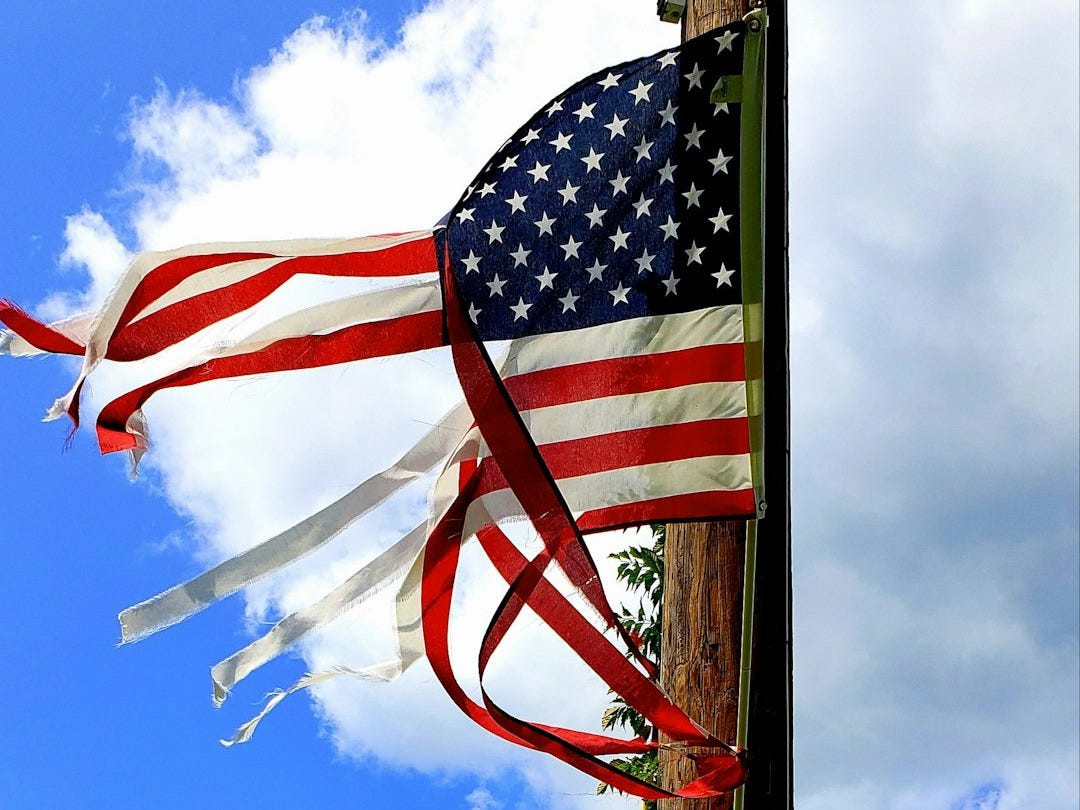
What Communities Shall We Imagine to Get Us Past America?
Jan Clausen calls on U.S. writers to reject nationalism

We writers had better imagine our preferred communities with care: if we are successful, a lot of future people will wind up living in the containers we invent…What communities shall we imagine to get us past America?
Welcome to Writer In The World, the Wednesday section of Aimee Liu’s MFA Lore. This curated collection of essays on the writing life and videos of Writers in Conversation is produced by acclaimed MFA faculty and alumni.
Aimee’s MFA Core essays on the craft and business of creative writing will drop each Saturday. And her free Metaphortography Writing Prompts post every Monday.
As an MFA Lore subscriber you can join our community and elect to receive some or all of these sections each week.
SPECIAL OFFER! Become a stronger writer and use your words to save the world:
America Isn’t (and Wasn’t) Great. What Now?*
by Jan Clausen
Viewed from the hellish depths of the second Trump administration, the 2016 essay below feels both obsolete and sadly relevant. Obsolete in the sense that we now rarely hear the invocations of a virtuous-at-the core U.S.A. that were popular when I wrote it. Relevant because the project of getting beyond the actually existing “America”—an entity founded on genocide and enslavement, whose creativity has largely consisted in refining its means of exploitation and domination—grows ever more pressing and perplexing. We’re in a “new” time, and yet we aren’t. I’m still mulling over a recent episode of the Red Nation podcast with Lakota scholar and author Nick Estes that focused on developments in ICE-occupied Minneapolis, the city where my father grew up. Estes pointed to contemporary echoes of 19th century atrocities perpetrated by white Minnesotans against the indigenous people of the region. I recently learned that several of my forebears were among those perpetrators, and I view my organizing on behalf of a BDS boycott at the Park Slope Food Coop as a roundabout way to address that legacy: a daughter of American settler colonialism in solidarity with Palestine. I’m pondering the little-noticed fact that the swaggering title given to the latest installment of U.S.-Israeli aggression against Iran, “Operation Epic Fury,” is plagiarized from Reagan’s “Operation Urgent Fury,” the 1983 invasion of Grenada referred to in my essay below. A line by Nina Simone comes to mind: “I wish I knew how it would feel to be free.” I wish we all knew how. Work to be done.
—Jan Clausen, March 2026
My mother, a lifelong liberal now in her 90s, was horrified by the outcome of the presidential election. As we commiserated, she said wistfully that my partner Winston and I could always move to Carriacou, the tiny island in the Eastern Caribbean where he was born and raised. Carriacou is part of Grenada, invaded by the U.S. in 1983. I reminded her of this, intending to suggest that (a) the problems far predate the recent election cycle and (b) you can run, but you can’t hide.
Today, calls abound for U.S. writers to mobilize against hate and looming assaults on free expression. Using the hashtag #writersresist, a group founded by poet Erin Belieu of VIDA has called for writers to come together and defend “[the] most basic principles of freedom and justice for all.”
This upsurge is encouraging—not just for the “fight back” message, but for the crucial recognition that effective resistance requires collective action; even those artists who typically work alone now need to refine our community building skills. But that realization in turn, begs the question: communities based on what? Imagined how?
Imagined Communities, as it happens, is the title of a book by historian and political scientist Benedict Anderson; the subtitle is Reflections on the Origin and Spread of Nationalism. Anderson’s influential notion of nations as imagined communities usefully encourages us to ask exactly whom we are, or want to be, in community with. It opens the way for the subversive idea that nations are not natural or eternal containers for our aspirations towards justice and our longing for solidarity. Given the artist’s obligation to, as Chinua Achebe has put it, “afford [oneself] through [one’s] imagination an alternative handle on reality,” we writers had better imagine our preferred communities with care: if we are successful, a lot of future people will wind up living in the containers we invent.
I bring this up now because, in my urgency to figure out what my communities of resistance are going to look like, I’ve been disheartened by the prevalence of nationalist rhetoric within a number of U.S. writing networks. Such appeals typically evoke a supposedly wonderful US of A–a country, it’s implied, that was on the right track until recently, or at least still possesses the potential to become an exemplar of just community. In a recent opinion column about countering Trumpism, Vietnamese-American novelist Viet Thanh Nguyen describes what’s at stake as the “contest for our American identity,” recommending “storytelling” as the path towards “opening hearts” instead of “building walls.” But why, I wonder, must opening hearts–a laudable goal–be centered on a deeply flawed nation state that is also a hugely destructive global empire? Is this the sort of community people need to imagine before they can commit to seeking justice and freedom?
Take a look at the PEN America Center’s #LouderTogether campaign, launched to combat “threats to freedom of expression and freedom of the press.” The web page reads, in part, “For many at home and around the world, the United States is becoming a locus of fear rather than hope….PEN America’s core mission—the freedom to write—now undergirds the preservation and promotion of every social good that has made our country great.” Why is PEN beating the drums for nationalism—and, let’s face it, not just garden variety nationalism, but the poisonous version known as American exceptionalism: the claim that it’s the natural place of the U.S. to serve as a beacon and “locus of hope” for the planet at large?
If it’s true that writers have a core responsibility to battle clichés and deflate received ideas, then it’s time we renounce the destructive fantasy of some lofty destiny for our deplorable empire. This is not a call to dodge the duties of citizenship; Virginia Woolf’s famous line, “as a woman I have no country” is only another form of wishful thinking. I do have a country, more’s the pity, and I am obliged to work to mitigate its harms, domestic and planet-spanning. However, my imagined communities of resistance will encompass the writings and activist examples of artists who’ve rejected the temptations of nationalism in favor of creating other modes of connection, other (and more realistic) frames for justice-seeking.
Here’s a brief sample of what I have in mind: Transnational feminists, writing borderlands (Gloria Anzaldúa, Theresa Hak Kyung Cha). Writers who’ve taken revolution seriously (Victor Serge, Frantz Fanon). Poets of the Caribbean/Pan-African diaspora (Kamau Brathwaite, M. NourbeSe Philip). Indigenous writers (like Leslie Marmon Silko, Elizabeth Woody, and Goddard MFAW alum Susan Deer Cloud) whose work re-centers us on the imagined community of humans with other living beings and the earth. Proponents of ecopoetics (indigenous and not) who remind us that the biosphere is our only authentic homeland. Contributors to Troubling the Line: Transgender and Genderqueer Poetry and Poetics (because nationalism revels in holding the line). The literature of an immigrant consciousness that is not about allegiance, but multiplicity (Bhanu Kapil, Elena Georgiou, Kazim Ali). The literature of worker solidarity (Meridel LeSueur’s “What Happens in a Strike,” Ousmane Semebène’s God’s Bits of Wood). Aimé Césaire’s Discourse on Colonialism. Samuel Delany’s and Octavia Butler’s and Ursula K. LeGuin’s and Sofia Samatar’s dreams of other worlds. The critics of other empires (Ma Yuan’s fiction about a Han Chinese encountering the trauma of Tibet; Svetlana Alexievich’s Second-Hand Time, featuring the voices of ordinary people experiencing the end of the Soviet Union). Fred Moten’s Undercommons, Audre Lorde’s House of Difference. Writers who frankly depict the U.S. as a morally failed state (Linh Dinh’s forthcoming Postcards from the End of America).
As David Wojnarowicz reminds us in Close to the Knives, his scorching memoir of queer desire, art making, and AIDS activism: “Soon all this will be picturesque ruins.” What communities shall we imagine to get us past America?
Jan Clausen is the author of a dozen books in a range of genres, including Veiled Spill: A Sequence, from GenPop Books (2014). Other recent poetry collections are From a Glass House and If You Like Difficulty. Prose titles include the story collection Mother, Sister, Daughter, Lover; the novels Sinking, Stealing and The Prosperine Papers; and the memoir Apples and Oranges: My Journey Through Sexual Identity.
Clausen’s poetry and creative prose are widely published in journals and anthologies; her book reviews and literary journalism have appeared in Boston Review, Ms., The Nation, Poets & Writers, and The Women’s Review of Books. More at ablationsite.org
Would you like MFA-level feedback on your work?
Becoming a Premium Member of the MFA Lore community will entitle you to Aimee’s written feedback on your query and up to 5 pages (1250 words) of your creative work, plus a follow-up phone call. Your “Take 5 Packet Letter” will highlight both the Strengths and the Opportunities in your work, helping you determine whether it’s time to “press send” to agents or reorient your revision. In addition, Aimee now leads a monthly zoom workshop just for Premium Loreates. To join, subscribe or upgrade to Premium and claim your Take-5 benefits today!
I’m pleased to invite you to our next Well Published, Live! with Jenna Satterthwaite . We’ll be chatting about her life and work as both author and agent. How DOES she do it? Please RSVP and tune in live using this link:
Well Published! is an occasional live/video feature of Aimee Liu’s MFA Lore, offering interviews with recently published authors and publishing professionals about the nitty gritty of getting… well published! Subscribe now to access the full archive of videos and other essential insights about creative writing and the writing life.