



Better to confront problems through a packet letter than leave them stewing in the work when it’s submitted to literary agents.
Dear Loreates,
I’m excited to introduce a new Premium offering here at MFA Lore, to bring you even more of the essence of an MFA education, should you desire it: the “Take 5” Packet Letter.
Now, when you upgrade to become a Premium Member, you’re invited to send me 1-5 pages of your creative work OR your next query letter, and I will respond with MFA-level feedback in the form of a Packet Letter, plus an optional follow-up phone call.
ALSO, starting January 24, you’re invited to join exclusive Premium Loreate zoom calls for deep-dive discussions of craft and publishing issues.
Why the fuss about Packet Letters? Well, that deserves a whole post, so read on!
P.S. This post may also be helpful if you give feedback in your own editorial services or writer’s group.
The Take 5 price will rise on January 1 to $180, so subscribe NOW to beat the hike:
What’s so great about Packet Letters?
The core of every low-residency MFA program is the packet of work that’s sent back and forth, from student to advisor for feedback, several times each semester. IMHO, these packets are the main reason why low-residency programs are more beneficial for most MFA students than traditional programs, where feedback is given only through workshop discussions. (I was shocked when writers who attended traditional MFA programs told me they’d never received any written feedback at all.)
I can’t speak for all MFA faculty, of course, but the packet feedback I received at Bennington and that most of my colleagues and I gave our students at Goddard was substantial, thoughtful, and organized. And packet letters are enduring. They can be referred to again and again. In fact, I often dip back into my packet files for nuggets of wisdom to share with you here.
But what’s most important is that packet letters you receive as a writer prepare you for the editorial letters you’ll receive when developing your manuscript for publication. Ideally, they’re detailed, honest, and pull no punches. They’re meant to help you clarify and strengthen the most compelling elements of your story while identifying the gravest impediments to its success. In this sense, they provide excellent practice for life as a published author, where revision is eternal and even your most enthusiastic agent or editor is going to demand improvements to make the book more marketable.
Packet letters, like editorial letters, accompany marked-up versions of the manuscript. Most MFA instructors have a cheat sheet of the codes they use as margin notes. Mine indicates my radar as a reader—and some perils we all need to watch out for in our own work:
√ -This is working!
√√ -This is gorgeous/brilliant writing!
awk -Awkward phrasing
Ha! -This made me laugh out loud (in a good way)
MORE - Something significant here needs to be more fully developed or clarified
MM -Mixed metaphor
Orient? -Problem with locating action in place, time, and context
OTT -Over the top; too much; purple prose; trying too hard
OTN -On the nose; lacks subtext; too obvious
POV -Point of view problem, shift, fuzziness
ROR -“Rate of revelation” is wrong; either the pace of revelation is too slow, or the revelations don’t make sense in the flow or context of other information
[ ] -Section in brackets sh/could be cut
Sp -Misspelling
VT -Verb Tense
wc -Dubious or incorrect word choice
? -I don’t understand what this means; line makes no sense
# -Needs a line break or page break here
¶ -Start a new paragraph
You’ll notice, no doubt, that far more of these notations signal problems than they do kudos. That’s not for want of desire. All serious readers, including MFA advisors, editors, or agents, want nothing more than to be swept away by a great book or story. But the reality is that virtually all early drafts contain an abundance of flaws. Some are structurally confusing. Some have extraneous characters or plot lines. Some are still finding their authentic voice. Even when readers are swept away by the promise of a piece, they can be stopped cold by confusing tense changes, tonal shifts, misplaced metaphors, wrong word choices, or simple grammatical mistakes. These stoppers need to be identified and cleaned up before the promise of the work can be realized.
In the beginning, when the work is still fledgling, packet letters can feel harsh. I always try to highlight the strengths and sources of emotional heat in the piece. Where do I feel an emotional investment? What is the work trying to signify? Why does this story matter? But it does the author no favors to ignore areas of confusion, repetition, or stagnation. Better to confront problems through a packet letter than leave them stewing in the work when it’s submitted to literary agents.
On the flip side, when a story’s close to fruition, packet letters often glow with praise and enthusiasm, suggestions for polishing and proposed next steps toward publication. I’ve directed students to professional editors who can help with their final polish. I’ve introduced them to agents when I felt the work was truly ready. There’s a contagion that grows around writing that’s beautiful, authentic, and compelling, and the vibe of a packet letter lets you know when you’re stoking that excitement.
Excerpts from a Packet Letter
To give you a sense of how this all works, I’d like to share some excerpts from one of my packet letters to Joanne Tompkins , with her permission.
JoAnne’s thesis novel, later published by Riverhead as What Comes After , was definitely one of those contagious projects, with drop-dead gorgeous phrasing, sensuous atmosphere, human drama that made your heart race, plus the most compelling dog in literature. Still, the novel had many revisions to go when I wrote my packet letter, and I like to think that some of my notes helped JoAnne prepare this already winning story for major literary success.
My packet letters often follow an arc, highlighting first Praise, then Problems, then Promise. I’ve found this to be a constructive pattern. See what you think:
Praise
Writers deserve to hear first what’s working, what their words hearken, where they seem to be leading.
I’m a slow reader, and this is a long book. Fortunately, it’s also a fabulous book, and I’ve savored these pages.
I think you have created a beautiful, powerful, and highly commercial literary novel. It reminds me a LOT of Kent Haruf’s Plainsong. I assume you’ve read that. If not, definitely do.
I’ve made lots of margin notes, flagging bigger questions and checking a small proportion of the magnificent moments. There’s so much wisdom and experience tucked subtly and well into this story. It’s very impressive.
Problems
This is the nitty-gritty of the letter. Most of this section zeroes in on specific scenes and lines and characters that aren’t yet pulling their full weight. Those particulars won’t mean anything to you, but here are a few general notes on JoAnne’s draft that you might relate to:
I’ll use this letter to describe some of the areas that struck me as problematic. Read: you might want to re-think or beef up your approach in a few areas.
Right off, I did not read the narrative voice as male…
As you revise, take a careful look at every element of the story, and make sure you either use and develop it to its fullest potential, or lose it.
I’m afraid the conceit of this intro simply doesn’t work for the book as now written. It’s misleading. And you don’t need it. I’d just cut the intro.
Promise
What’s the promise of the process? Where is this project heading? How close is it to that elusive finish line of publication? To send out, or not to send out?
I want to repeat that this book is fundamentally wonderful. It’s going to be an easy sell, I think, once the wrinkles are worked out. Revision won’t necessarily be a quick process, but in the grand scheme of things, what needs to be done is minor. You’ve got a terrific situation and story, rich and complex characters, deeply felt and wise insights on love and loss, a fabulous sense of place woven throughout. The quality of writing is top notch, and your sense of pacing and surprise keeps us eagerly turning the pages.
I do think you want to get this as close to “perfect” as you can before approaching agents, but once this is ready, I expect they’ll leap at it.
So keep at it, with relish and encouragement. I can’t wait to read the final draft and help you roll this out.
In case you’re curious, you can read about that roll out here:

When a Packet Letter helps the most
No guarantees come with packet letters. As with any read from an agent, editor, or publisher, the feedback you get from an MFA advisor will be largely subjective. We all have different literary tastes, and certain genres, like dystopian sci-fi and romance novels, have their own rules, which few MFA advisors (including me) are familiar with. So always make sure you’re getting feedback from someone familiar with your genre.
Also remember that even high praise does not mean the work is ready for prime time. While encouragement can be worth a lot, it’s no shortcut or substitute for the work of revision. JoAnne kept revising for two more years before selling her novel, and then spent another year revising it to her Riverhead editor’s satisfaction. This writing business is a long haul.
But there are three points at which a packet letter can be especially helpful:
When you’ve got a really shitty first draft and can’t tell if there’s anything there worth pursuing. If you have a tough enough stomach to take the criticism of the parts that aren’t working, an early objective read can be invaluable to help you find the heat.
When you have a draft that you think might be close to ready to send out. If you want to save yourself the pain of needless rejection— and are prepared to keep revising, this is a great time to get a second opinion before pressing send.
When you’ve been sending the work out and no one’s biting and you don’t know why. A packet letter at this point can help you make sense of the rejections and perhaps get a fresh take on potential revisions.
If you’re at any of these three stages with your current story, an MFA Lore “Take 5” Packet Letter might be of use to you.
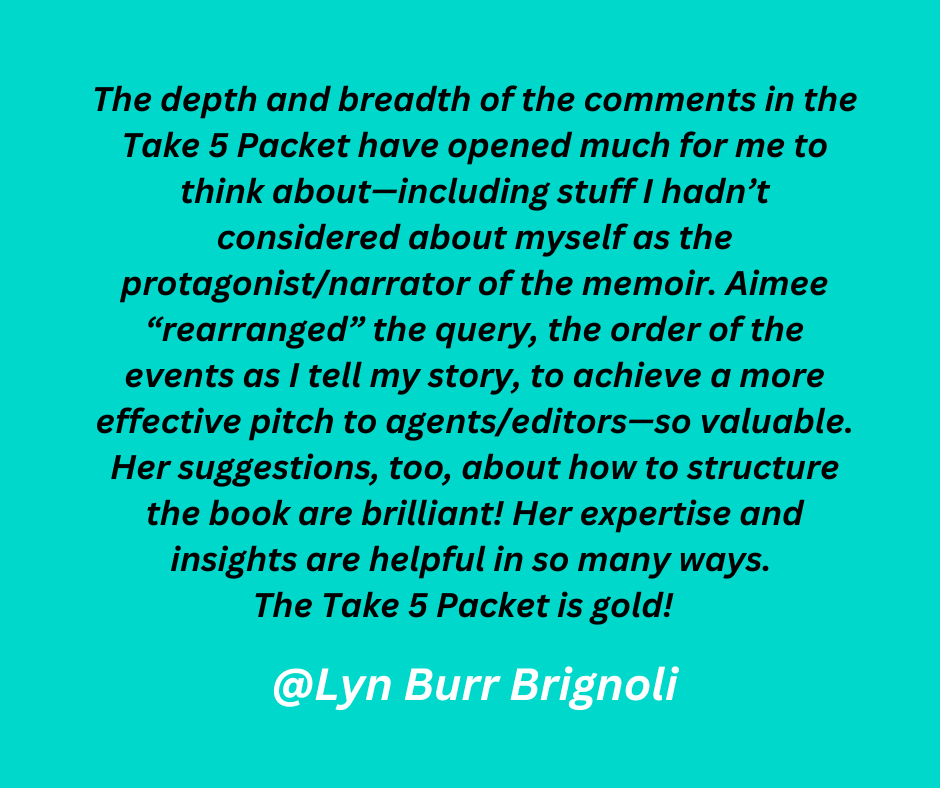
Get your own “Take 5” Packet Letter from MFA Lore!
Yes, I’m “only” offering feedback on 5 pages, but rest assured that most agents or editors will need no more than 5 pages to decide whether to ask for more. Likewise, if your query letter doesn’t grab them, they’ll never make it to the beginning of your manuscript.
Another reason I’m offering feedback on your first or most important 1-5 pages is because these pages will (ideally) encapsulate the essence of your book’s promise, resonance, and merit. They’re an excellent gauge of the integrity and coherence of your overall concept. These 1,250 words should have the power to draw any reader in cleanly and clearly and hold their attention. They should crackle with electricity and snap with direction. If they don’t yet do that, I want to help you figure out why.
Become a Premium Member for $140 and sign up for your “Take 5” Packet Letter now — the price will rise to $180 on January 2!
Premium Members of the MFA Lore community receive:
Aimee’s written feedback on both your query and up to 5 pages (1250 words) of creative work, plus an optional follow-up phone call. Your “Take 5 Packet Letter” will highlight both the Strengths and the Opportunities in your work, helping you determine whether it’s time to “press send” to agents or to reorient your revision.
Exclusive monthly zooms just for Premium Loreates
And all other benefits of a paid subscription.
Subscribe or upgrade today!
The MFA Lore Packet Letter offer is still in the testing phase. Please tell me what you think.
I’m listening!
Your Editorial Prompt: BYO Faculty Advisor!
Here’s an exercise you can apply every time you get ready to revise. Pretend you’re your own MFA advisor. Use the chart of margin notes from this post to check your manuscript for the all the noted Strengths and Opportunities.
Check for each item separately. Highlight what’s working, what you love, what stands out as exceptional writing or emotional conflict. Where do you laugh out loud? Then go through the work again on the lookout for awkward phrases, copy edits, half-baked scenes or ideas, POV and ROR problems, etc. You’ll have your marching orders when you finish!
As the first writer to have taken advantage of Aimee's offer, allow me to say that the service she is providing is, in a word, invaluable.
All of her subscribers here know Aimee for the highly accomplished author that she is. However, as someone who has also run a respected MFA program herself, it should come as no surprise that she brings a wealth of experience as a teacher to the process of evaluating and editing the work of other writers.
In my case, having wrestled with the approach I was taking to the opening of a novel on which I've been working, Aimee's fresh perspective of the first five pages has given me a clear sense of the direction that I need to take. (And I say this as someone who will now have to put in a lot of work to revise those pages in accordance with the overall notes and specific line edits contained in my packet letter!)
Besides, Aimee's offer of providing premium members with this service at zero additional cost makes it an absolute steal. I was quick to grab it and I couldn't be happier.
This is great! I’m very interested. How can I set it up?