Writing Prompt: HALF
Visual inspiration + mental exercise to start your writing week
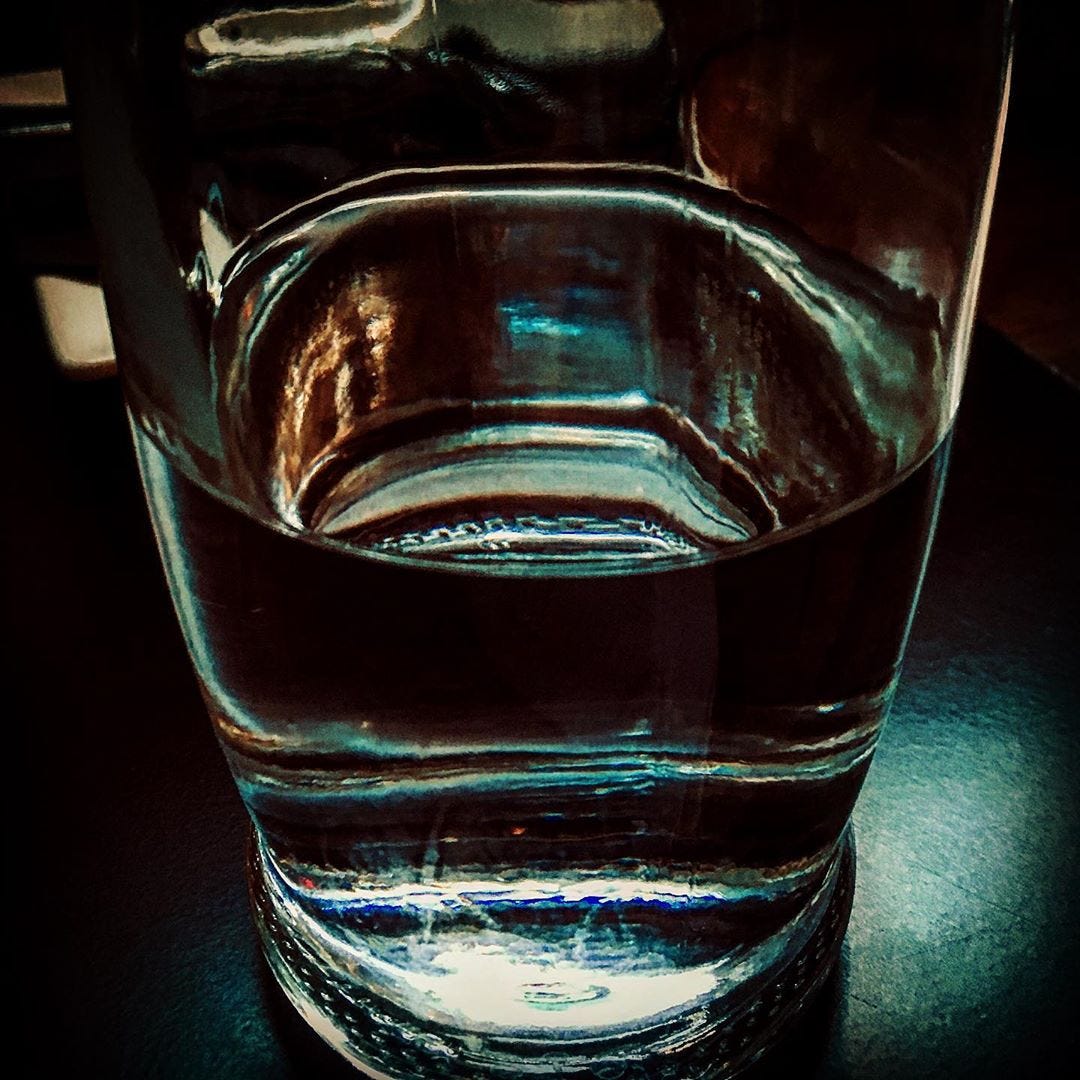
I see a glass filled with equal parts water and air, I see my father. Half Chinese, half white American. Not one half or the other, but both together in one, he lived forever straddling that middle line, the most distinctive part of him. It made him elusive, indefinable, uniquely beautiful and mysterious as no whole version of one or the other half could ever be.
Metaphortography Prompts are free visual and verbal writing prompts for inspiration and reflection. This is the Monday section of Aimee Liu’s MFA Lore. Our Wednesday section is Writer In The World, a curated collection of essays on the writing life by acclaimed MFA faculty and alumni. Writers in Conversation and other MFA Core essays on the craft and business of creative writing will drop each Saturday. Receive some or all of these newsletters by subscribing now:
SAVE THESE DATES!
Wednesday, February 18 at 6:30 pm PT
Telling Family Secrets Author Panel
Does your writing suffer from Fear of Family (FOF)? If so, you won’t want to miss this free online panel with Toni Ann Johnson , juanita e. mantz , Hannah Sward , and Aimee Liu .
Tuesday, March 3 at 11 am PT
Well Published: Short Stories with Rachel Khong
I’m absolutely thrilled to welcome Rachel Khong, author of Real Americans and Goodbye Vitamin, for a chat about the release of her new story collection My Dear You.
HALF
The great dilemma, less or more. Rising, or falling? Filling, or emptying? Richer, or poorer, for being equal to another in the overall scheme of things? For the implicit middle line that for some unknowable reason dictates identity?
We’re all born half/both. Mother, father, 1+1= you. Or used to be. Science now offers alternatives to challenge genetic symmetry. Mirroring a society that takes nothing for granted. Even the human component.
No wonder some lean backwards, grasping, clinging to the illusion of wholeness, wholesomeness, purity as some attainable, superior, “greater” good. The threat isn’t being reduced by half; it’s atomization.
Too much, too confusing, too complex to contemplate. Reality always has been. So much simpler to target and hate the most obvious symbol of your fear that the great dilemma’s answer is less for you, not more.
In truth, to be half is to be incomplete yet, implicitly, to belong. To the other, to the whole combination. To make and represent and recognize and need more than just yourself. There’s an old Chinese story about a general leaving for war who breaks a mirror and takes one half while leaving the other with his beloved; only by marrying the two halves when they meet again decades later can they know each other.
I see a glass filled with equal parts water and air, I see my father. Half Chinese, half white American. Not one half or the other, but both together in one, he lived forever straddling that middle line, the most distinctive part of him. It made him elusive, indefinable, uniquely beautiful and mysterious as no whole version of one or the other half could ever be.
The wonder is where the two halves meet. That touching, aching, tantalizing promise of something new and different. When you are half one thing and half another, your whole is richer by half than anyone all the same.
Don’t let anyone tell you otherwise.
Half: Middle English, from Old English healf; akin to Old High German halb half. The first known use was before the 12th century.
: either of two equal parts that compose something
: one of a pair
: being one of two equal parts
: amounting to approximately half
: falling short of the full or complete thing
: covering only half
: not completely
Here is your writing prompt:
As you contemplate the image above, conjure a situation where having or being half of something causes a dispute. The nature of the dispute is up to you, but as you write through and around it — in fiction, nonfiction, poetry or prose — factor in the following:
How does each participant define “half”? Why do they hold this view?
How does the focus on halfness, i.e. one of two equal as opposed to many parts, affect the intensity of the conflict?
What is truly at stake in this dispute? Power? Possession? Identity? Resources? Attention?
What led up to the dispute?
What is the context for this situation?
What would it mean to each participant to have or be “whole”?
Is this dispute negotiable, or is it a zero-sum contest? Why and how?
How is a resolution reached?
What is that resolution?
Is there a winner and loser? What constitutes winning and losing?
What changes in the aftermath? Do the participants learn anything?
* Optional related reading for ideas: Sally Rooney’s novel Intermezzo.
Loreates’ Corner
I’m delighted to introduce you to a few of the wonderful stacks by writers in our community. Please read, subscribe, and share! And if you’re an MFA Lore subscriber with a great writing stack that I haven’t mentioned, please drop the link in a comment, so I can add you to our Corner.
Jack Cameron writes Tacoma Stories
Sandell Morse writes Double Espresso :


Great read 👏🏻