Anatomy of an Op-Ed
To find the formula for an opinion piece, tweak the formula for a hit book

Every author needs to learn how to write op-ed pieces. Getting these essays published is more challenging today because so many newspapers have folded, but they’re still one of the best ways to promote a book and raise your profile, whether as an expert in your field or as a literary virtuoso. An op-ed piece in a major outlet like the New York Times not only gives you credibility but it reaches thousands of readers who likely would not find you any other way.
Hello Loreates,
Been another banner week for the history books. We’re feeling all the feels, I know. Meanwhile, we trudge forward, trying to get our “regular” work done. Whatever regular means anymore.
In this space, “regular” means trying to help you finish and get your work published well. One way I do that is by sharing the lessons I learn as I struggle to write, sell, edit, and promote my own work. This week that struggle leads me into the realm of op-ed pieces.
Every author needs to learn how to write op-ed pieces. Getting these essays published is more challenging today because so many newspapers have folded, but they’re still one of the best ways to promote a book and raise your profile, whether as an expert in your field or as a literary virtuoso. An op-ed piece in a major outlet like the New York Times not only gives you credibility but it reaches thousands of readers who likely would not find you any other way.
When you write for a major newspaper, you get paid a nominal fee (usually around $200) in exchange for the rights to publish and syndicate the work. The paper can change the headline at will and sell the piece for republication under your byline. This can get your words in front of readers around the world in the space of hours. And if your bio mentions your book title, all those thousands of readers will also learn about you and your book.
Over the years, I’ve published many op-eds, mostly in my hometown paper, the Los Angeles Times. I’ve written about my Chinese grandfather’s experience at UC Berkeley in 1906, about vaccination , real estate porn, and anti-Chinese racism. As far as I could tell, the opinion piece that reached farthest was “Hello Today,” about the daily email system that my brother and I established with my mother after my father died. I got mail from readers of small newspapers I’d never heard of in towns I’d never heard of.
Those successes taught me that the formula for a winning op-ed is not that different from the formula for a bestselling book — the UUU formula I’ve described here:

But today I’m working to formulate an op-ed piece related to my ghost project, which will be published this spring. It’s not a slam dunk. Opinion pieces right now must be short, tight, compelling, and perfect for the news cycle of the day they’re published. It sometimes feels as if you need a crystal ball to be able to write one that the NYT will accept.
When struggling to write in a particular form, I find it helpful to deconstruct successful models for what I’m trying to do. So that’s what I’m going to do in this post: deconstruct an op-ed that caught my eye recently, held my attention, and left me with a richer perspective for reading it.
Before I begin, you might want to read this exemplary op-ed in full for yourself. Here’s the NYT gift link to “They Were Ordinary Germans. We Are Ordinary Americans” by Shalom Auslander . You can also read it on his Substack here.

SAVE THESE DATES!
Monday, February 9, 2026, at 10 am PT/ 2pm ET
Writers In The World, Live: Create to Survive
Please join WITW’s Substack Live MFA faculty reunion, as Elena Georgiou, Sherri L. Smith and Aimee Liu discuss the essential role of creativity as an engine for solace, hope, and resilience in today’s tormented world.
Elena Georgiou is the award-winning poet and fiction writer who formerly directed Goddard’s MFA in Creative Writing Program and currently teaches in the PhD program at the Rubenstein School at the University of Vermont. Sherri L. Smith is an award-winning author of fiction, nonfiction, and graphic novels for young adults and kids, and a faculty member of Hamline University’s MFA in Children’s Writing.
Tuesday, February 10, 2026, at 11am PT/ 2pm ET
Well Published, Live: Publication via Contests
On Feb. 10, I’ll be chatting with Toni Ann Johnson , who’s won FOUR writing contests that led to publication of her books. Her next is a story collection, But Where’s Home, to be released on February 10 by Screen Door Press, an imprint of The University Press of Kentucky. Join us to find out how she did it!
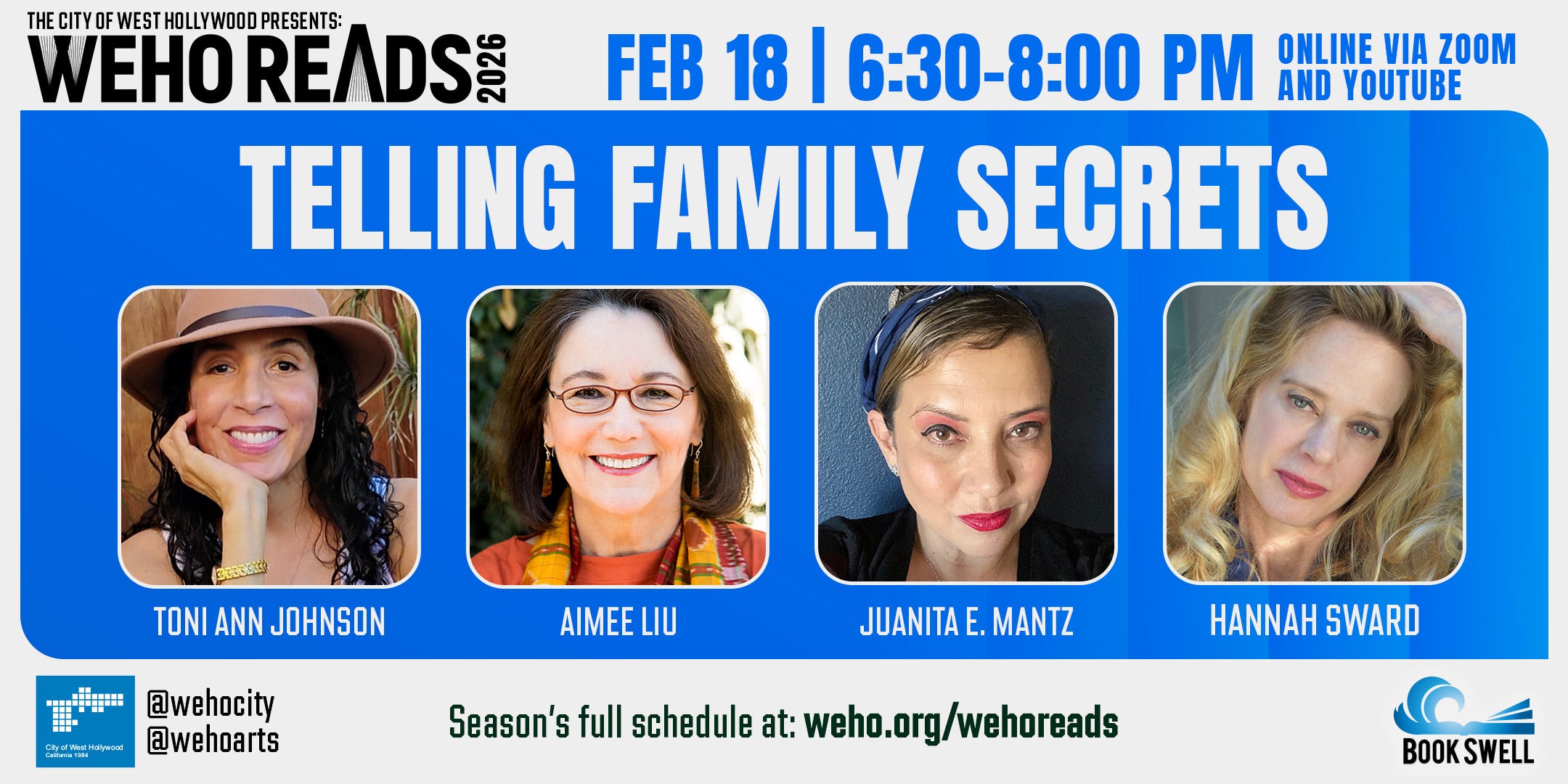
Wednesday, February 18, 2026, at 6:30 pm PT
Telling Family Secrets Author Panel