

How to Get Your Book Past Literary Agency Gatekeepers
These tips will help you fast-track your pitch to top agents


Remember that your query doesn’t represent only your work; it also introduces you as the Author. Your query letter, in particular, needs to present both your distinct personality and your authority for writing this book.
Hello Loreates,
I’m still buzzing from my Well Published! interview Tuesday with William Morris Endeavor nonfiction literary agent Dara Kaye. The clips from this convo are getting thousands of well-deserved views. ICYMI, please scroll down to the end of this post or catch up HERE. Dara was so generous with her time and wisdom and memorable formulae for checking the readiness of proposals for submission (X+y=Z ; LCR; the So-What Factor). Don’t miss it!
One of the issues we talked about was the relative value of boutique agencies vs. “bigtime” agencies like WME. Dara has worked for both, and she made a good case for the variety of expertise available at large talent agencies. For instance, if she has a client who wants to write a version of their book for the theater or movies, Dara has plenty of colleagues at WME who can help.
But having been represented by a major agency since early in my career, I know that bigtime agents tend to rely more heavily than boutique agents on outside readers and associates to filter incoming submissions. These early readers tend to be overworked and underpaid, and new authors understandably worry about getting their work past them. So I thought I’d address that concern, with some practical tips for getting through and around the screening process, today.
If you’re getting ready to submit your book to agents, read on!
Aimee
Save the Dates!
Take 5 Writing Workshop
Saturday, August 29, 9am PT/12pmET
This monthly workshop for Premium MFA Lore Subscribers allows us to take a close look at a different 5-page submission each month, tailoring feedback to the needs of each writer. To join, become a Premium Subscriber today.
Well Published! Live with
A Mighty Blaze Founders Caroline Leavitt & Jenna Blum!
Tuesday, Sept. 1, 10amPT/1pmET
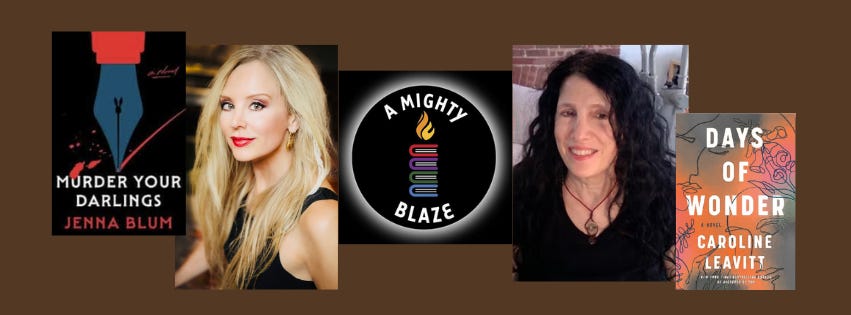
Jenna Blum and CarolineLeavittville are two prolific authors who founded A Mighty Blaze, a promotional powerhouse for authors, which continues to grow on Substack. Join us to talk about the transformative power of this literary community for authors and readers alike.

Literary Agencies Have Many Doors
I signed with my first literary agent in 1978, when I was fresh out of college. Ancient times, I know, and simpler, too. A writer friend stopped by my apartment, saw my manuscript, sent a copy to his agent, and within weeks the agent sold it.
Granted, I did have a significant hook (what agent Dara Kaye calls the So-What Factor): my first book, Solitaire, was also America’s first anorexia memoir. I’d been anorexic for seven years at a time when eating disorders were on the rise and no one— including doctors and families— had any idea that these were true mental illnesses. I’d researched everything available at the time, and my memoir took readers on their first trip inside the life, compulsions, and thoughts of someone gripped by anorexia. The project fulfilled what I’ve since come to coin as my own magic formula for selling a book: Unique + Urgent + Universal. It was almost complete when I sold it, and polished enough to convince editors that I’d deliver.

Even so, there was far less competition back then, and many more paying publishers, since they hadn’t yet consolidated into the Big Five. The volume of submissions was lower because it was more logistically challenging to write a publishable book before the advent of word processors, and far fewer writers seriously imagined themselves as authors. This meant that everyone in the publishing industry had more time. Most agents read every incoming manuscript themselves and forged enduring bonds with their clients. As evidence, I’ve been represented by my agent for over forty years. Today, the landscape has changed.
The rise of gatekeepers
I’ve moderated many agent panels for writing programs and conferences, and at almost every one the agents bemoan the sheer volume of submissions they receive. If they had to vet the continuous stream of submissions by themselves, they’d have no time to represent their clients. This is why many boutique agents who do vet their own submissions now only accept them periodically.
Big agencies are more likely to be open to submissions year round, but their agents generally rely on assistants and hired readers to decide which manuscripts they’ll see. This system has led to understandable concern among emerging writers that agency gatekeepers won’t give their work a fair read. Who are these readers, anyway, and how can they be trusted to distinguish one writer’s diamond from another’s dud?
