



“It was when I was going through all the papers that I had from her, and made some discoveries that I hadn’t known would be in there, that the form of the essay and just the desire to write the essay came about.”
Thank you Katie Gee Salisbury, Amy Wallen, Julie Neches, Laurie MacIntosh, Homi Hormasji, Shirley H Bekins, and many others for tuning into my live video with author and essayist Karen Shepard.
Well Published, Live! is a free video series from MFALore.com
Every few weeks Aimee interviews prominent authors, editors, literary agents, and other book industry professionals about the experience of getting… well published!
For archived video conversations visit Well Published! at MFALore.com:
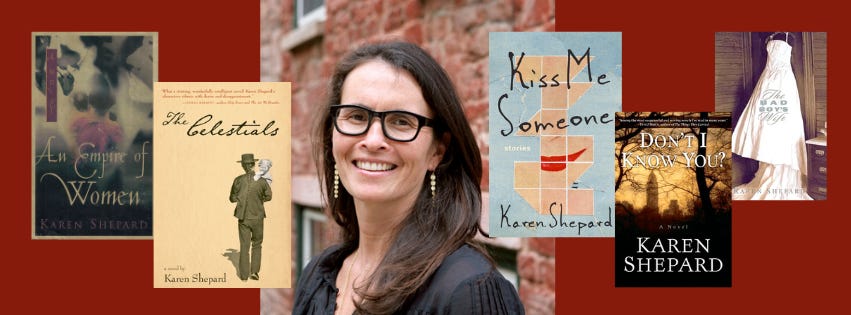
Karen Shepard is a Chinese-American writer, born and raised in New York City. She’s the author of four novels, An Empire of Women, The Bad Boy’s Wife, Don’t I Know You?, The Celestials, and the collection of stories, Kiss Me Someone. Her short fiction has been published in the Atlantic Monthly, Tin House, The Paris Review, and Ploughshares, and her nonfiction has appeared in More, Self, USA Today, and the Boston Globe, among others. She has three children, and teaches writing and literature at Williams College in Williamstown, MA, where she lives with her husband, novelist Jim Shepard, and their two beagles.
We talked about the complexities of epistolary memoir writing, in general, and the specifics of her extraordinary epistolary essay, “The World Is an Easier Place Without You In It,” recently published in The Paris Review.
We also talked about difficult mothers, the ways our mutual mixed-race identity informs our writing, why and how writers’ conferences are valuable in a writing life, what it takes to get published by The Paris Review, and how Karen and Jim Shepard manage their two-author marriage!
You can watch the whole video above, and/or read the major takeaways below.
Takeaways from Karen Shepard
On the Paris Review Essay and Its Origins
“It was when I was going through all the papers that I had from her, and made some discoveries that I hadn’t known would be in there, that the form of the essay and just the desire to write the essay came about.”
The essay grew from a specific discovery process: after her mother died by assisted death in Switzerland, Karen went through her mother’s papers and found a trove of saved correspondence — letters between her mother and grandmother Han Suyin, and crucially, letters her mother had salvaged from Han Suyin’s apartment. The essay’s spine came from Karen’s own email exchange with the Swiss clinic’s caseworker, who followed up to ask how she was doing. That email prompted her to “accordion out” the story.
On Finding Structure in Memoir
“What do you need to know from the past to understand the moment we’re in right now? I don’t need to tell you everything. I need to tell you enough.”
Karen uses a “need-to-know” principle for backstory — give readers only what they need to understand the present moment, not a full biography. She likens it to pulling someone into a car before a party and giving them just enough context to navigate the room.
Her structural model for the essay was the progression toward Switzerland as a narrative spine, with past material woven in to show readers who these two people were — and why their late-life connection was so unprecedented. She wanted readers to feel the same simultaneity she lived: the sixty-year-old Karen trying to manage the four-year-old Karen during hospital visits.
On Selecting Material
“Which of these forces me to see something that I would prefer not to have to see? That tends to get put in.”
Karen describes casting a wide net through primary documents and trusting a physical sensation — a “frisson” — to identify what’s emotionally resonant, even when she doesn’t yet know why. She also notes that she initially excluded letters showing her mother’s psychological astuteness because she wanted a particular portrait of her — and then had to confront what she was protecting herself from by doing that. That self-interrogation became a guiding principle.
On Memoir’s Particular Pitfall
“I am writing, whether it’s fiction or nonfiction, to discover things. Something new about myself, not in an epiphanic way necessarily, but just, I come out slightly different than I went in.”
Karen identifies the urge to protect oneself as a larger risk in memoir than in fiction, because the stakes are higher with real material. She distinguishes sharply between blame (accusatory, shame-based) and responsibility (agentive, empowering), arguing that good memoir requires the latter — asking how the writer is complicit in the situations she’s unhappy with. The trope of well-meaning people buffeted by the world — is what she most wants to avoid.
On the Unsent Letter
“It felt a little like a gift from beyond, from the future and the past. It was heartbreaking for a lot of reasons. One, the need, her own need, that was so beautifully articulated in it.”
Among the most affecting discoveries in her mother’s papers was a typed, unsent letter in which her mother asked: What did I do with you that you didn’t like? What would you have liked me to do that I didn’t do? Karen describes it as a “heartbreaking gift” — evidence of emotional astuteness her mother rarely expressed, and of a need she could never voice directly. Karen’s conclusion, reached partly through writing the essay: her mother was capable of connection with others but found Karen “structurally terrifying” and couldn’t get out of her own way with her.
On Publishing in the Paris Review
“The Paris Review’s fact-checking is — I’m reading all these mainstream media news stories that are insanely wrong, and I’m going, well, if only they had the Paris Review fact checkers.”
The pathway was through her agent’s subsidiary rights person, who submitted the essay. The Paris Review accepted it quickly. The editorial process was rigorous — thorough fact-checking, requests to see all original documents in full, and substantive cuts. The main cut was family text threads and voice memos from Switzerland, removed to maintain narrative acceleration toward her mother’s death. Karen plans to restore that material in the longer book about her family.
On Writing as a Mixed-Race Person
“I felt quite powerful being mixed race. I felt like I had a foot in both worlds, in a kind of very stable stance — like my legs were sort of hip distance apart. And I felt stable as a result of it.”
Karen felt her mixed-race identity gave her a slight outsider perspective on both worlds — which she experienced as advantageous rather than destabilizing. She contrasts this with Han Suyin, who suffered considerably from being mixed race in an earlier era and responded by asserting control over her own narrative in multiple, often contradictory versions. Karen notes that the narratives imposed on you shape the kind of storyteller you become — you either bow to them or push back.
On the Two-Writer Household
“To have a partner, a life partner, who absolutely believes in the value of going off and locking yourself into a room and sitting at a desk for many hours a day — is really extraordinarily helpful. And priceless, really.”
Karen and her husband, fiction writer Jim Shepard, function as each other’s first readers, calibrating their feedback to the stage of the work — looser responses to early drafts, rigorous line editing later. She explicitly rejects the zero-sum view of literary success: when writers she admires get attention, she sees it as good for literature broadly, not as competition.
On Writers’ Conferences
“You’re spending time with people who don’t question in any way what you hope to do with writing and what you value about reading and writing.”
Karen sees conferences as valuable for the same reasons as MFA programs: time with people who share your commitment, exposure to diverse feedback, and the formation of lasting communities. She notes that many students from Sirenland and Tin House have gone on to become long-term reading partners, blurb-givers, and collaborators.

Save the Dates!
Saturday, May 30 at 9am PT
Take 5 Writing Workshop
This monthly workshop for Premium MFA Lore Subscribers allows us to take a close look at a different 5-page submission each month, tailoring feedback to the needs of each writer. To join, become a Premium Subscriber today:
Tuesday, June 2, at 10am PT
Well Published, Live! with novelist Julie Buntin on her new book ‘Famous Men’
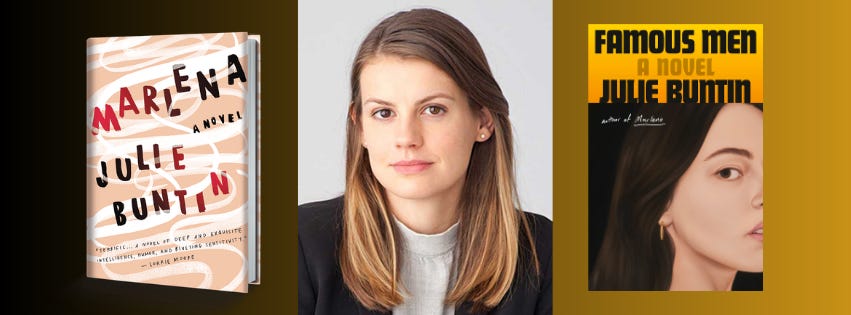
I’m delighted to invite you to my next Well Published, Live! with novelist Julie Buntin, whose new novel, Famous Men, is forthcoming from Random House in July. Her debut, Marlena, was a finalist for the National Book Critics Circle’s John Leonard Prize and longlisted for the Center for Fiction’s First Novel Prize.


