
0:00
/
Transcript

Well Published! Mega-bestselling Christina Baker Kline on Bad Editors, Hooking Readers, and Challenging Yourself as a Writer

A recording from Aimee Liu's live series on the art and business of getting... well published!

Thank you Human Potential & Resilience, Sheri Handel, Julie Neches, Homi Hormasji, Laurie MacIntosh, and many others for tuning into Well Published, Live! with Christina Baker Kline .

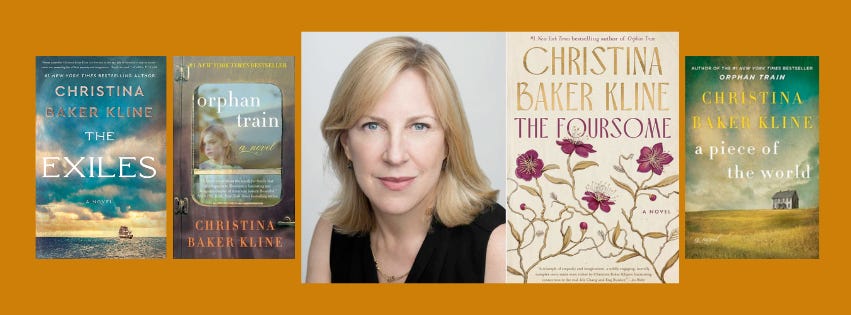
Christina is the #1 New York Times bestselling author of ten novels, including Orphan Train and The Exiles, and she currently serves as vice president of the Authors Guild. Her new novel The Foursome will launch on May 12!

Buy The Foursome!

We talked about everything from the invaluable advice she got by confronting her worst editor, to the astronomical success of her surprise bestseller Orphan Train, to the challenge of writing 19th-century sex scenes about Siamese twins in The Foursome! And, of course, we talked about the many reasons every writer on the planet who is serious about having a writing career must join the Authors Guild.

Check out the Authors Guild

You can watch the whole video above, and/or read the major takeaways below.

Save the Date!

Tuesday, May12, at 10am PT

Well Published, Live! with Karen Shepard on her Paris Review publication and writing about mixed-race families

I’m delighted to invite you to my next Well Published, Live! with novelist and essayist Karen Shepard. We’ll be chatting about her latest publication — an epistolary essay!—in The Paris Review and about the challenge of writing mixed-race stories.

Reserve May 12 Live!


Takeaways from Christina Baker Kline

On Career Resilience and Surviving Difficult Stretches

Christina described a crisis period following her second novel when she was simultaneously raising three young boys, ghostwriting a book that ultimately collapsed (the scientist had exaggerated her role on the research team), working under a high-profile but incompatible editor, and struggling financially after a move. The result was an eight-year gap between books. Her central advice: choosing the right editor matters more than chasing prestige. The “star editor” who won a small bidding war for her second novel was flashy but unsupportive:

“It was flashy, but she wasn’t good for me. She wasn’t nurturing. And I needed that then more than I need it now . . . Going with an editor who may not be the big name can be a terrific thing to do.”

Christina later signed with a then-assistant editor who proved deeply nurturing. That editor is now head of fiction for the Atria Publishing Group.


Share

On the Career-Changing Advice That Led to Orphan Train

Despite finding her second editor harmful overall, Christina credited her with three blunt notes that ultimately transformed her writing:

(1) be less cerebral, give the reader more heart and visceral feeling

(2) expand the canvas — write with an awareness of the larger world and historical moment, not just the intimate sphere of the story

This post will help you expand the canvas of your story:

(3) “write more like a man,” by which the editor meant: take on bold, large-scale stories and resist the urge to resolve things neatly.

Christina described working with that advice for years before it led her to Orphan Train — her fifth novel and a phenomenon that spent two years on the New York Times bestseller list, including a year in the top five, and sold many millions of copies.

“I would say it served me well even though she did not really serve me well.”


On Orphan Train‘s Unlikely Rise

The book was published as a paperback original — generally not a sign of high expectations — because her previous novel, Bird in Hand, had underperformed. Christina was hesitant but trusted her new editor. The book connected, she believes, because it illuminated a largely unknown piece of American history: the “orphan trains” that swept roughly 30,000 street children off New York’s streets and deposited them in Midwestern labor placements. By the time she finished writing, there were only 25 surviving train riders; she credits the book’s word-of-mouth success in large part to the estimated 4 million living descendants who found personal connection in the story.

“It was a hidden piece of American history that people actually cared about . . . I think all the descendants of those people were the readers. They were the people that found the book and they told their whole families.”


On the “Historical Novel” Label

Christina resists the term, calling it a “female ghetto.” She pointed out that writers like Colson Whitehead, whose work is equally rooted in history, are not routinely labeled “historical novelists.” She prefers Hilary Mantel’s formulation: “contemporary novels set in the past.” Her approach is to write in a modern register — character-driven, emotionally direct — while setting stories in periods and places that have been overlooked or underexplored.

“I like delving into a story that people don’t really know, or some angle of a story that has been hidden or unexplored.”


On Her New Novel, The Foursome

The novel (forthcoming May 12, 2026) is based on a true story with direct family connections: Christina and her cousin are distant relatives of the two women who married the conjoined twins Chang and Eng Bunker. Despite knowing the story for decades, she did not feel ready to write it until she had finished The Exiles, which is set in the same 1840s period.

Buy The Foursome!

She described the central imaginative challenge in The Foursome as making the arrangement feel human and non-exotic to readers — specifically, writing about intimacy and sexuality with honesty while drawing on research into living conjoined twins (who speak openly about dating and relationships) and historical records of “alternate mastery,” the Bunkers’ documented system of rotating between wives every three days. The book also confronts slavery directly: Chang and Eng were themselves exploited as children before becoming, paradoxically, significant slave owners in North Carolina. Christina said she could not tell the story without reckoning with the complicity embedded at every level of antebellum life.

“My goal for the entire book is that you would see them not as this other, but instead really imagine what it was like to be part of an arrangement like that . . . There’s a line in my novel: ‘Even the most extraordinary life seems ordinary when you’re living it.’”


On Agents and Cross-Genre Work

Christina has had four agents over her career. Her long-term first agent died after twenty-five years with her; subsequent agents were mismatches — one too hasty, one unwilling to support her range.

“I did change agents because I wanted someone who was interested in cross-genre work. I didn’t want to have different agents for different things.”

She is now with WME, which she values specifically for its comfort with cross-genre and cross-platform work. She has written fiction, nonfiction, co-authored a thriller under the pseudonym Anna Baker (with her friend Anne Burt), developed a television project, and was briefly involved in launching a publishing imprint before deciding that writing had to remain her priority.


On the Authors Guild

Christina became vice president after several years chairing the organization’s annual gala. She is a forceful advocate for membership, noting that the Guild now offers tiered membership open to aspiring and self-published authors — not just those with traditional deals. Key member benefits include free contract vetting, legal support on issues ranging from AI to book banning to free speech, and affordable author websites. She called the Guild especially vital given the current climate.

Join the Authors Guild!

“Now more than ever, the Authors Guild is actually at the forefront of all kinds of major issues in the press.”


On Daily Life and Productivity

Christina described herself as a skilled compartmentalizer — able to switch fully between writing, advocacy, and promotional work without carrying each into the other. She acknowledged she does not write every day, particularly during book launch periods. She writes longhand, a habit she traces to her historian father. She noted that New York City, where she now lives, suits her and that with her three sons grown, she has more sustained time to write than she has had in decades.

“I’m good at compartmentalizing. So when I turn to something, I can turn off the other thing pretty well.”

Would you like MFA-level feedback on your work?

Benefits of a Premium Subscription to MFA Lore include membership in the Take 5 MFA Lore community. This will entitle you to:

  • Written feedback on both your query and up to 5 pages (1250 words) of creative work, plus an optional follow-up phone call. Your “Take 5 Packet Letter” will highlight both the Strengths and the Opportunities in your work, helping you determine whether it’s time to “press send” to agents or to reorient your revision.

  • Our exclusive monthly zoom writing workshop, just for Premium Take 5 Loreates.

  • Full access to paid posts and MFA Lore archives, and all other benefits of a paid subscription.

Subscribe at the Premium level or upgrade today. Details HERE:

Take 5 Program


Discussion about this video

User's avatar

Ready for more?