



“Imagination can be fueled by . . . love—applying love to your imagination. And when you do that, then it sort of expands outward and you can imagine these different worlds, a different way of doing things.”—Rachel Khong
Hello Loreates!
I was deeply honored this week to welcome award-winning fiction author Rachel Khong to Well Published, live!
Thank you Joshua Irving Gershick, Homi Hormasji, Jeff Curry, Essence555, KATHYA ALEXANDER, and many others for tuning in. You can watch the whole video, above.

Well Published, Live! is an occasional video feature of Aimee Liu’s MFA Lore. These conversations with acclaimed authors, agents, and book industry professionals is meant to help you get… well published!
Aimee’s MFA Core essays on the craft and business of creative writing drop each Saturday.
My conversation with Rachel is a cornucopia of inspiration, advice, and wisdom for fiction writers and creative artists of all stripes. It ranges from the challenge of finding focus and motivation amidst geopolitical turbulence, to specific tips for using short stories to develop ideas for novels, with stops along the way for approaches to writing about race and incorporating science into fiction when you’re not a scientist!
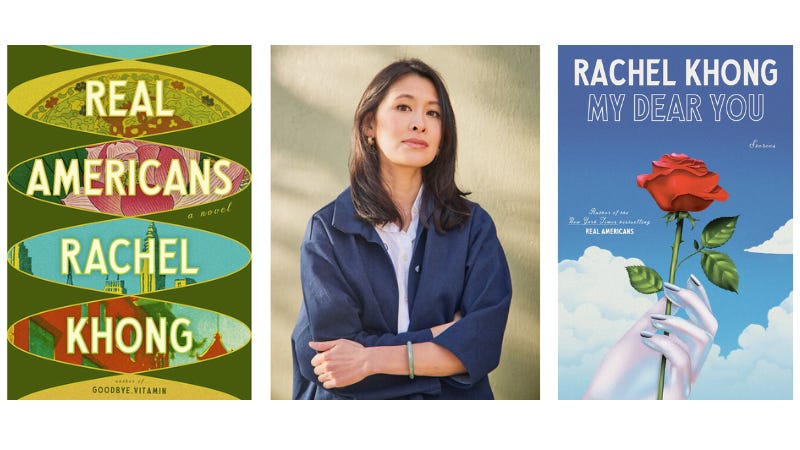
For those who aren’t familiar with Rachel’s work, allow me to introduce you:
Los Angeles writer Rachel Khong is the author of two award-winning novels and a new story collection. Her debut novel, Goodbye, Vitamin, won the 2017 California Book Award for First Fiction, and was a Los Angeles Times Book Prize Finalist for First Fiction.
Her second novel, Real Americans, was published by Knopf in April 2024, and was an instant New York Times bestseller. [I had the privilege of reviewing Rel Americans for the LA Times, and you can read that review HERE.]
And her newest title, My Dear You, will be out from Knopf this April.
I urge you to watch and savor the entire conversation, but in case you’d like a quick rundown first, below are a few of my favorite things that Rachel had to say.
Takeaways from my conversation with Rachel:
On writing amid political turbulence “I really am such a firm believer in carving out that creative space. . . . We have to hold the reality close to us because that’s where the writing comes from—what we’re feeling, what we’re living through, and our reactions to whatever injustices.”
On short stories vs. novels “I write stories when I’m writing novels because they remind me that I can finish something. A novel, for me, takes years and years. It’s often really frustrating. I’m banging my head against the wall. I feel a lot of despair.”
On not knowing where a project is headed “I never know at the beginning what anything is going to be or what form it’s going to take. I’m very attuned to what the project wants to be. And often the characters will tell me.”
On assembling a story collection “As I was putting these things together, I realized the book was about one’s limits as a person and the reality that the life you lead is likely the one life that you’re going to lead and that you don’t get to live all your possible lives and go down all possible paths.”
On race in her fiction “I was interested in writing about the racism that’s a little bit more insidious and kind of subtle even, and often very funny because it is so random. . . . I don’t wake up in the morning and think, like, oh, I’m going to go about my day being Asian. . . . That’s not on my mind every single moment of the day.”
On writing about science without being an expert “The cool thing about writing is that you could just learn about stuff and you don’t need to be an expert in it. . . . I think it’s valid to learn as much as you can and not be an expert, to just let your curiosity guide you and to be open to the fact that you might be wrong about anything.”
On revising old work “I didn’t want it to reflect who I am now. I wanted it to have the energy of who I was back then. . . . The book that you write is a document of all these different versions of yourself, right? And the person who starts the book is not the same as the person who finishes the book.”
On the MFA and literary community “Even if you’re not in a program, I think just finding other writers who care about writing as much as you do is so invaluable because really most of the world doesn’t care. . . . I think it’s so hard to write over many years, to have that kind of stamina, without a community of people who understand why you do what you’re doing.”
On journaling as a writing practice “I often will journal before I start writing my fiction because sometimes it helps me clear my throat a little bit, helps me figure out, okay, here’s what I’m interested in today. Because we’re not machines. Every day we’re coming to the writing a little bit differently and interested in different things.”
On imagination and love “Imagination can be fueled by . . . love—applying love to your imagination. And when you do that, then it sort of expands outward and you can imagine these different worlds, a different way of doing things.”
Would you like MFA-level feedback on your work?
Becoming a Premium Member of the Take 5 MFA Lore community will entitle you to:
Aimee’s written feedback on both your query and up to 5 pages (1250 words) of creative work, plus an optional follow-up phone call. Your “Take 5 Packet Letter” will highlight both the Strengths and the Opportunities in your work, helping you determine whether it’s time to “press send” to agents or to reorient your revision.
Monthly zoom writing workshops with Aimee, just for Premium Take 5 Loreates.
Full access to paid posts and MFA Lore archives, and all other benefits of a paid subscription.
Subscribe at the Premium level or upgrade today. Details HERE.


