



“What are we being told when we’re told to write a certain way, especially as young women, and what does that mean and how can we challenge those things?”
Thank you to Lily Chien-Davis, Jack Cameron, Jane Valentine, Mejukah Weeber and the many others who tuned into my live video with Julie Buntin! What a rich conversation we had about living and writing the moral complexities that woman navigate in the #metoo era. Julie offered many great tips, too! You’ll want to watch the whole video if you missed us live, but for your convenience, I’ve recapped some of the wonderful take-aways below.
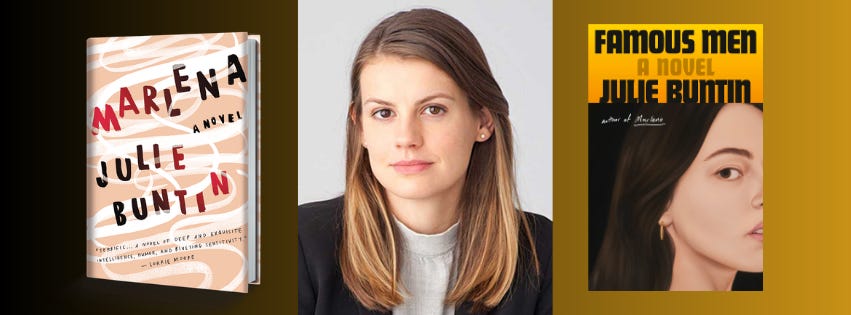
For those who don’t know her, Julie Buntin is the author of FAMOUS MEN, coming on July 14 from Random House. It’s already received Starred reviews in Kirkus and Booklist!
Julie’s debut, Marlena, was a finalist for the National Book Critics Circle’s John Leonard Prize and longlisted for the Center for Fiction’s First Novel Prize. Her writing also has appeared in The Atlantic, Harper’s, and The New York Times,
Julie was an editor and director of writing programs at Catapult. She has taught creative writing at NYU, Columbia University, Marymount Manhattan College, the Yale Writers’ Workshop, Lighthouse Writers Workshop’s Lit Fest, and now, she is an assistant professor at the University of Michigan.
AND in September, Norton will publish Julie’s collaborative nonfiction project, Notes to New Mothers, co-edited with Rebecca Dinerstein Knight. In our conversation, Julie reflected on how she and Rebecca had dismissed their postpartum writing as “not real work” — only to discover it was some of the most resonant material either of them had produced:
“We thought these notes and jotted-down things, these texts people were sending to each other — the breastfeeding logs and records of ways that bodies were changing — were actually this amazing view into the creative change that happens to women writers postpartum.”

Julie Buntin on breaking the rules to make your literary work stronger
“A lot of us have this experience as writers — we don’t actually know what we’re talking about until we write the story.”
On finding your story
Find the story that hasn’t quite been told in that territory
Julie was drawn to the professor-student dynamic precisely because she wanted to approach familiar tropes from an unfamiliar angle.
“Famous Men is playing with a lot of tropes. We’ve seen stories about professors and students before. And I became really interested in this idea of what it would take for someone to have to find a kind of backdoor into this world - not as a student, but as a witness - and what would it feel like to always be on the outside in this particular way.”
Let privilege give you permission to critique the system that granted it
Julie reflected that having published Marlena and been admitted to MacDowell gave her the standing to write a novel that questions those very gatekeeping structures.
“Having access to relative privilege as a writer — being taken seriously as a writer — gave me permission to write a book that is in some ways a critique of the systems that decide who gets taken seriously as a writer.”
Consider giving your protagonist outsider-insider status
Rather than making Will an MFA student, Julie placed her just outside the program — close to its world but never fully of it.
“Having Will be a character who isn’t officially in the MFA program, but still very much witness to it — because of her close relationship to Nathaniel — offers an interesting lens on the workshop. What else might she notice that the others can’t see?”
Resist reducing female characters to victims or heroines
Julie built Will’s contradictions deliberately, pushing back against the impulse to make her either purely sympathetic or purely culpable.
“What made Will interesting to write is that she is a person who is full of contradictions, like all of us are. She is naive, but she’s also kind of calculating at the same time.”
Let your setting carry emotional charge
Both of Julie’s novels draw their settings from places she was longing for while writing. Homesickness for a charged place was part of what unlocked her imaginative energy. She wrote Marlena while missing northern Michigan and Famous Men while missing New York, and in both cases the longed-for place became vividly present on the page.
Span time ambitiously if the story calls for it
Julie was deliberate about writing a novel that followed a character across decades, inspired in part by Great Expectations.
“I wanted to take on the challenge of writing a big sprawling story where you go on a journey with a protagonist and when you get to the end you are like, I’m surprised we’re here but also not surprised we’re here — how did we get here, what are all the things that led to this point?”
On writing a novel
Sense your ending before you begin
Rather than plotting in advance, Julie emphasized holding an emotional or sensory sense of where the book is going. She also noted that she abandoned another novel mid-draft when she lacked that orienting sense, suggesting it matters more than writers might expect.
“I would describe it as a feeling, like a sensation, almost like a physical or spatial awareness of what that was going to feel like when I got there. I knew where the books were going to go or what feeling I wanted to leave readers with.”
Start from a personal emotional truth, then follow the story wherever it leads
Julie described beginning from something deeply felt but then releasing any obligation to autobiographical fact.
“I start from something quite personal and then have no faithfulness whatsoever to the reality of my own life once I start writing. I start with the truthful feeling and then I do whatever feels right for the story until by the end I almost don’t recognize it.”
Use a physical condition to carry multiple thematic threads at once
Rather than stating themes directly, Julie built Will’s heart condition into the novel as a way of embodying gaslighting, class precarity, and the cost of self-silencing all at once… not merely a plot device but a way of making several ideas visible simultaneously.
“It’s a way of talking about class. It’s a way of talking about money. It’s a way of talking about desperation and precarity. But it’s also a way of highlighting a character who is receiving messages from all sides not to trust what she perceives…I was very interested in kind of creating a narrative counterpoint or a physical manifestation of some of the kind of issues around gaslighting and harm that we experience in her relationships with men.”
Let an open ending serve the book’s larger argument
Rather than resolving Will’s story tidily, Julie left certain questions in the reader’s hands — and saw that openness as thematically necessary.
“The ending does leave certain decisions in the hands of the reader — decisions about what’s next for Will and whether she’s really escaped this situation and if she has taken control or claimed her own agency, whether the sacrifices she made were worth it. I hope these are questions that readers will argue about.”
Wait until the draft is done to fully reckon with its thematic context
Julie described keeping the larger cultural conversation — Me Too, the Alice Munro revelations, Claire Dederer’s Monsters — somewhat at arm’s length while drafting, then allowing those pressures to inform revision. She began from character and only later recognized the larger ideas at work.
“A lot of us have this experience as writers — we don’t actually know what we’re talking about until we write the story and then we’re like, oh yeah. A lot of those questions were coming in more once the draft was done and I was revising, because I think that’s a time when I’m starting to think about thematics a little bit more — how those things are working once the story is mapped out and the characters are shaped and formed.”
On breaking the rules
Write toward what you don’t understand
Julie talked about gravitating toward subjects that felt morally unresolved or narratively unfamiliar. She said the questions driving both her novels remain unresolved even after writing them — and that’s the point.
“The books are just ways of getting into the question, I think, and looking at it from different ways and trying to figure out something I can’t quite grasp.”
Be willing to subvert received writing advice
Julie discussed using Famous Men as an opportunity to question the rules she had absorbed in her MFA.
“What are we really being told when we’re told to write a certain way?”
The MFA is not the only path — community is what writers actually need
Julie was direct that an MFA is neither necessary nor sufficient for a writing career. What matters, she said, is finding your people:
“I don’t think you need an MFA to publish a book. I don’t think you need an MFA to become a writer… Writers need community, and you can find that in a lot of ways.”
Yes! Writers in Community…
Save the Dates!
Saturday, June 13 at 10am PT
Loreate Salon for Paid Subscribers
All paid subscribers are welcome as we discuss the thorny issues bedeviling our collective writing life. Please RSVP in the chat, and include any topics you’d like us to discuss:
Saturday, June 27 at 9am PT
Take 5 Writing Workshop
This monthly workshop for Premium MFA Lore Subscribers allows us to take a close look at a different 5-page submission each month, tailoring feedback to the needs of each writer. To join, become a Premium Subscriber today:


