



Thank you to everyone who tuned into my live video with the incredible scholar, legal anthropologist, and anti-nuclear peace builder Annelise Riles. In addition to all her other world-saving work, Annelise publishes Everyday Ambassador here on Substack.
Our conversation ranged from the power of literature to wage peace and the importance of bringing geopolitics down to a human scale through stories, to the urgent need for writers and peacebuilders to remember the moral complexity on all sides of conflict. If war is fueled by dehumanization of the enemy, then peace can only be achieved when humanity is mutually restored to enemy and ally alike. Literature can play a critical role in reminding us all of our shared humanity.
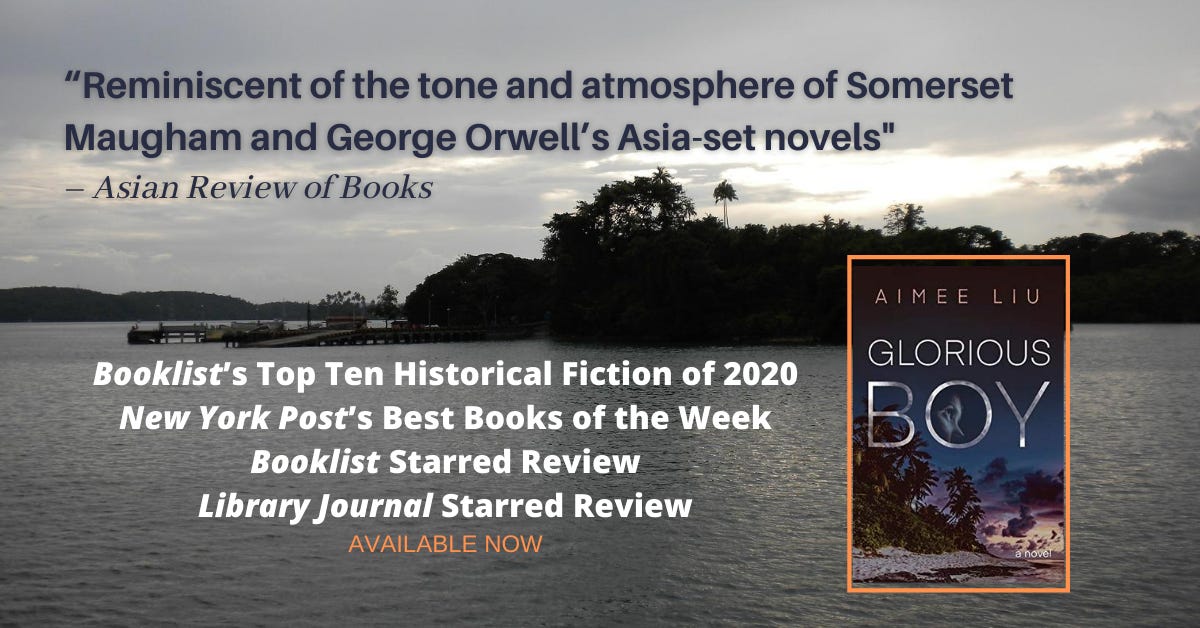
I was honored that Annelise wanted to focus on my novel Glorious Boy in our discussion. As one of my characters says in the book, “The most difficult thing is to remember that the enemy is human, but this is also the most important…especially when I find myself being my own worst enemy.” This became one of the anchors for our conversation.
Please read on for some of the advice we shared for writers and for peacebuilders, and watch the whole video above.

Annelise Riles & Aimee Liu on Glorious Boy, War, and the Peaceful Power of Literature
Take-aways for writers and for peacebuilders
“The first step to war is to dehumanize someone.”
Dehumanization is the precondition for violence and war.
For writers: if your antagonist reads as pure monster, you’ve likely skipped a step. The most unsettling — and most useful — fiction shows the incremental process by which someone stops seeing another person as fully human; that mechanism, rendered on the page, is often more instructive than the violence it enables.
For peacebuilders: treat the language of dehumanization as an early-warning signal, not background noise. When a group starts being referred to in animal, alien, or vermin terms in public discourse, that’s a concrete point of intervention — not a rhetorical flourish to shrug off.
“The stories that we consider to be literature are much more nuanced, they’re much more complex... they get down through all of those surface layers, whereas propaganda really just sits right on the top layer of what people see.”
Literature counters propaganda by refusing simplicity.
For writers: complexity isn’t just an aesthetic choice, it’s a moral one. When you resist the urge to make a character simply good or simply bad, you’re doing the opposite of propaganda’s work — and that resistance is often where a book’s lasting power comes from.
For peacebuilders: complicate the narrative deliberately. Introducing nuance into a black-and-white public story — showing the humanity on a demonized “other side” — is itself a peacebuilding intervention, not just a communications strategy.
“These very human one-to-one decisions, one-to-one relationships end up literally saving the world.”
Individual relationships — not institutions — are what actually avert catastrophe.
For writers: scale your stakes down before you scale them up. A global crisis becomes legible to readers only through the lens of one relationship, one decision, one person choosing to act against orders — anchor the epic in the intimate.
For peacebuilders: invest in the unglamorous work of one-to-one ties across a divide — a single sustained friendship or collaboration can outlast an entire generation of official diplomacy. Don’t wait for institutional cover to restart a relationship that’s gone quiet.
“The perpetrator and the victim are both damaged in incalculable moral ways.”
Moral injury damages both victim and perpetrator.
For writers: sympathy for a perpetrator character isn’t the same as excusing them — it’s a craft tool. Showing what an act costs the person who commits it, not just the person who suffers it, adds a dimension readers rarely get from history books.
For peacebuilders: build moral injury into how you think about reconciliation work. People who were compelled into complicity — soldiers, low-level enforcers, bystanders — often need their own pathway to accountability and healing, not just blanket condemnation or blanket forgiveness.
“Writing Glorious Boy did change me... there were a lot of things that I knew when I started the book that opened up and took root in unexpected ways by the end.”
Writing fiction changes the writer, as well as the reader.
For writers: if you finish a draft holding the exact same beliefs you started with, you probably didn’t let the material do its work. Deep research and embodiment of a character should unsettle your assumptions somewhere along the way — that’s a sign the book is doing more than identifying a problem to fix.
For peacebuilders: stay suspicious of your own certainty. If years of dialogue or fieldwork with “the other side” haven’t changed any of your assumptions, you may be extracting rather than genuinely engaging — real encounter should leave a mark on you, too.
“One of the benefits of fiction is that it can reach people who otherwise aren’t thinking about it.”
Fiction reaches people in ways that history and journalism can’t.
For writers: don’t underestimate the reader who picked up your book “just for a good story.” A well-told narrative can smuggle in history, politics, and empathy to people who would never seek out a textbook or op-ed on the same subject — that backdoor is a real form of influence, not a lesser one.
For peacebuilders: partner with storytellers rather than treating culture as separate from your work. A novel, film, or memoir can move an audience your policy brief will never reach — build those relationships deliberately into your strategy.
“It’s the grandchild’s generation that is hopefully interested and feels safe enough that they don’t have the hang-ups or the fears that shroud it all in mystery, so they want to open up and solve the mystery.”
The grandchildren’s generation is often the one that can finally unearth what parents kept silent.
For writers: if you’re working from family history, notice where the silence sits — what wasn’t said is often more structurally important to the story than what was. Distance from direct trauma can be a craft advantage, not just a personal one, giving you access earlier generations didn’t have.
For peacebuilders: recognize generational timing in reconciliation efforts. Some truths can only surface once the generation that lived them has passed and the fear has thinned — design long-horizon truth-telling processes accordingly, rather than expecting disclosure on an institutional timeline.
“Culture leads and law follows.”
Culture often delivers the accountability that law and politics fail to.
For writers: a story can do reputational and moral work that courts and legislatures are too slow, too compromised, or too politically constrained to do. Don’t discount the real-world weight of simply telling a suppressed story accurately and vividly enough that it can’t be ignored.
For peacebuilders: don’t wait on formal justice mechanisms to move first. Public truth-telling, testimony, and cultural memory work can create the conditions that eventually make legal or political accountability possible — sequence your strategy with that in mind.
“The real pain of war is that you’re forced to make moral compromises... in a way that breaks you, and that you can’t quite put back together again.”
Family history reveals the moral compromises ordinary people are forced into during war.
For writers: the most honest war or conflict narratives resist tidy allegiances. Let characters make compromises that don’t fit a clean moral arc — the discomfort that creates in the reader is often the point, not a flaw to smooth over.
For peacebuilders: build space in your work for people who were neither clean heroes nor clean villains — the ones who switched sides, stayed silent, or complied to survive. Reconciliation processes that only have room for victims and perpetrators miss most of the population actually living through conflict.


